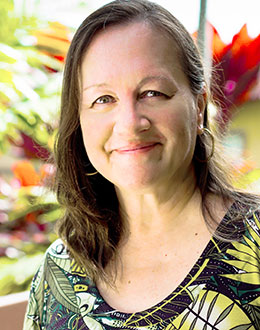
Native Hawaiian journalist Hannah Kaʻiulani Colburn is a digital news producer at Hawaiʻi Public Radio and an in-demand freelancer for the Office of Hawaiian Affairs’ Ka Wai Ola O OHA. Many of her articles focus on the native community. Her wide-ranging interviews reveal the vibrant artistic community that’s thriving in Hawai’i.
Today we talk story with Hannah about her writing life.
Mahalo for speaking with us this morning! Let’s start in the Hawaiian way. Please share a bit about your background and your ‘ohana.
My father is half Hawaiian, half Japanese; however, he was adopted as a child by the Coburn ʻohana – a large local family from Lāʻie.
I was raised outside of Sacramento, California. I did not attend a traditional high school. Instead, I graduated through an independent study program, which is similar to being homeschooled. (Note: Hannah graduated from the University of Hawai’i journalism program.)
My mother has been one of my most important supporters. From the time I was young, she instilled in me to always work hard and get an education — those two things, no one can ever take away from you. She’s just always there for me whenever I need her and has always supported me 1,000%.
Also, I would not be able to write and work without my other half. He’s a big help when it comes to taking things off my plate so that I have the time to work on my stories. We also both share a huge love for our culture and Hawaiʻi. So he’s a great supporter of my overall work.
Mahalo for sharing this. How would you describe your job title and job description?
As a freelance writer, I have the flexibility to choose whether I take an assignment. Freelancing for Ka Wai Ola is always a pleasure!
A breakdown of the job is that I am asked to take on a story assignment and am given a deadline, usually between 1 and 2 weeks, to turn in a story for their monthly issues. A typical assignment will require me to speak with my subjects or sources, gather photos, and then write a story.
Why did you become a writer? How long have you been doing this work?
I have always enjoyed storytelling and writing; it has always felt natural to me. In college when I was debating what to study, I found myself between English and Journalism and was encouraged by a professor in Los Angeles to study Journalism. After graduating from the University of Hawaiʻi at Mānoa in the fall of 2024, I kept up with freelancing whenever the opportunity arrived. It’s been over a year now since I’ve been working professionally as a writer in my field.
What do you like most about your job? What do you like the least?
Writing for Ka Wai Ola has been very special to me! I reached out to the paper as a student struggling in my capstone class at UH. Pua, the editor for KWO, responded and gave me the chance to write a story of my own for the paper, and since then, I have become one of KWO’s regular contributors. Working with Pua has been something I will always cherish. Besides being an amazing writer and editor, she has been someone who has mentored and advised me. She makes the process seamless and easy and has just always shown me aloha!
Something else I enjoy is being able to speak to other Hawaiians, hear their stories, and have the opportunity and trust to share them with others. It’s not easy to answer questions, especially for someone who is a stranger. You never know what they could gather, so I really try to take the time to connect with my subjects, their stories, and make them feel understood.
I have zero complaints doing this work!
For readers who might be interested in becoming freelance writers, what do your typical working hours look like?
It all depends on the turnaround time from when I get an assignment to arranging talk story sessions. But for the most part, it is quick. I don’t like to sit on a story for too long, but I also don’t like feeling rushed. I prefer to work on a story for five to seven days. It gives me time to listen back to my interviews, transcribe them (I don’t like using AI transcribing tools), work out an initial draft, and then revise. Due to my other job, my role as a mom to a busy 18-month-old, I usually work on my stories after hours, early in the morning, or late into the night.
What’s your research process like for a typical article?
I like to spend a day before speaking with a subject to really do my research into who they are, what they’ve done, and what I’m going to be writing on. The research will usually continue as I’m writing a story.
Can you please share some examples that you believe show your best writing?
Yes! Here of some of my favorites:
- Leading a New Generation with Arts and Culture
- Wearing Tradition in the Kamehameha Day Parade
- ʻŌlelo Hawaiʻi YouTube Channel Preserves Hawaiian Culture through 3d Animation
(Hannah also interviewed me for an article at KWO: Sharing Kahoʻolawe’s Story with a New Generation of Writers)
Are there any topics you like writing about most?
I enjoy working on stories that aim to uplift or perpetuate Hawaiian culture. All of my stories have some sort of Hawaiian lens to them, which is extremely important to me. However, I truly enjoy highlighting other Hawaiians and giving them a space to share the work they are doing for the lāhui.
What are your hopes and dreams for the year and beyond?
I always hope to continue to write and create. Ever since I became a mom, I have wanted to start writing stories for keiki, which I hope to do one day. My sister is a talented illustrator, so we have always discussed the idea of collaborating on a project together.
I would also like to see myself be more involved in the community, getting out there and doing ʻāina-based work myself. So many Kānaka are out there organizing and being the boots on the ground for others. I don’t see myself working in an office, sitting at a computer all day long. I want to start doing more hands-on work and fostering change in Hawaiʻi by advocating to return to traditional and Indigenous practices.
What advice do you have for aspiring freelance writers?
To bet on yourself and work hard! No one else is going to do the work for you, so reach out, network, talk story, get to know people that you want to be aligned with, and champion you. Don’t bother with those who don’t believe in you or your stories. Not everyone will share that same perspective.
Can you share a bit about what you are working on next?
For KWO, I never know what story I’ll be getting next, which is part of the excitement! For my job with HPR, I hope to speak with some village members of Puʻuhonua Waiʻanae after the new year for a story. They are in the process of moving out of the boat harbor and some are settling into permanent homes on land deeper within the Waiʻanae Valley. I want to see if the transition into their new village is as the media is presenting it.
Do you have a website? What does your social media presence look like?
I don’t have an updated website. Something that I need to take some time to do! I am definitely more private on social media. I only follow family and friends and don’t use it as a platform to brand myself. I am always open to connecting with others, though!
What advice would you give your younger self?
What is meant to happen will happen. Trust the ride and you’ll get to where you’re meant to be.
Mahalo, Hannah, for sharing your story with us! We wish you much aloha and continued success!
Image courtesy of Hannah Kaʻiulani Colburn.