Book Review: I AM A BON DANCER by Brandi-Ann Uyemura

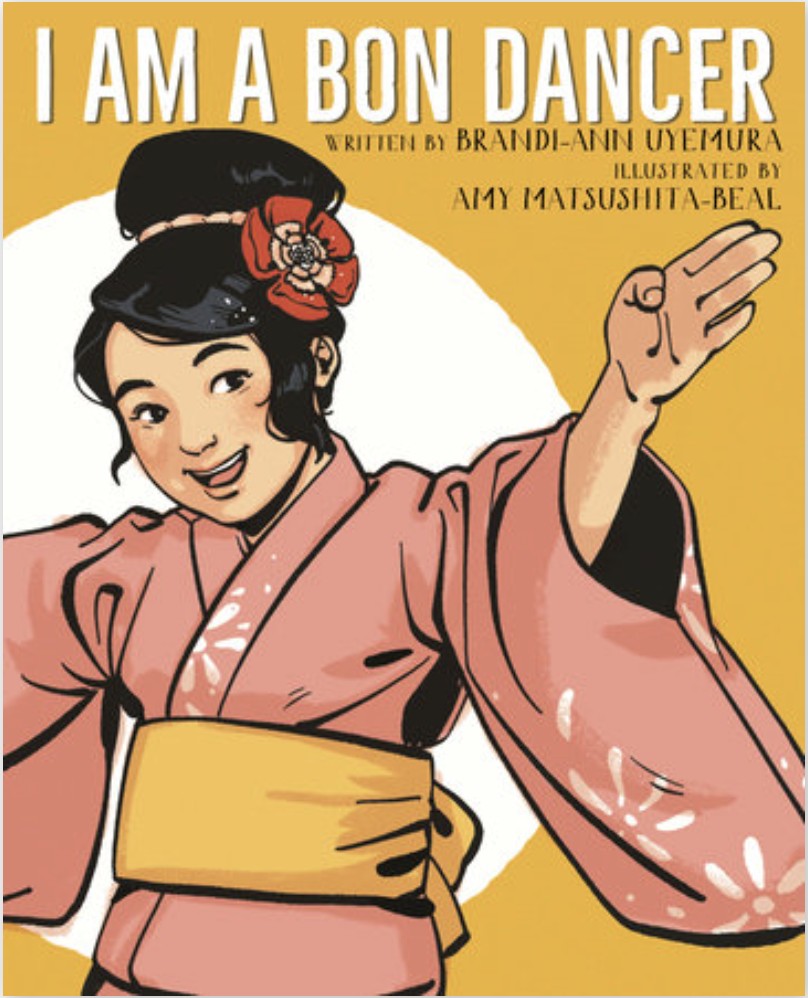
Cover I am a Bon Dancer

Hawai’i is blessed with a diverse population, in large part due to our sugar plantation history. Hard-working people from far away places as China, Portugal, Japan, Puerto Rico, the Korean peninsula, the Philippines, and Russia settled here, raising their families and contributing to what has become our unique local culture.

This is reflected in fifth-generation Japanese American Brandi-Ann Uyemura’s delightful debut picture book, I am a Bon Dancer.

Cover I am a Bon Dancer
Cover illustration @ Amy Matsushita-Beal from I am a Bon Dancer by Brandi-Ann Uyemura (Holiday House, 2026)

It’s Obon season in Hawaiʻi, and our young protagonist is excited to attending her first festival. Accompanied by her beloved grandfather, Grandpa Jo, the young girl is immediately entranced by the sounds, sights and aromas of the Bon dance. Most of all, she is in awe of the graceful dancers who move together, clapping, sweeping their arms and stepping to the music.

Will she ever learn to dance as beautifully?

What follows is a  tale as the little girl learns how Bon dances are connected to her ancestors. I was especially moved by the image of the young dancer with her Grandma Nat, who had worked as a field hand on a sugar plantation. Feeling love and encouragement, the girl gathers her courage, feels the music within her, and begins to dance. 

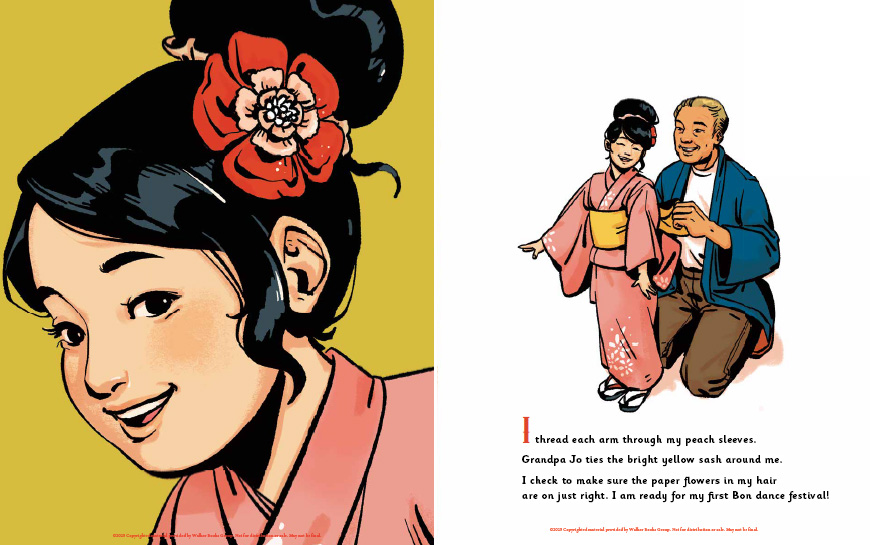
Opening pages
Illustration @ Amy Matsushita-Beal, from I am a Bon Dancer by Brandi-Ann Uyemura, Holiday House, 2026

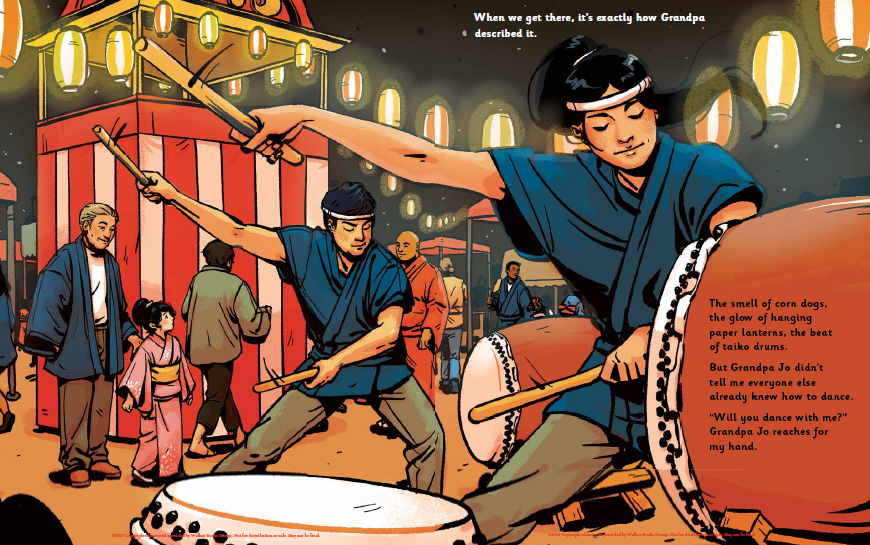
The illustrations by Amy Matsushita-Beal are beautiful. Because Bon dances tend to be held during evening hours, the book’s scenes are saturated with deep blues to represent the evening sky. One of my favorite spreads shows the girl entering the  for the first time. We readers share her wonder and excitement — the thumping beats of the drummers, the tall red and white striped tower strung with brightly colored lanterns, the tents beyond that hint of delicious treats.

Although Obon is a Japanese tradition, the illustrations include diverse faces. As a girl, I attended Bon dances with my Japanese language school classmates, so I appreciate that the dancers are an authentically accurate reflection of the open-to-all invitation of the festival. 

I love back matter, and the material at the end of the book is very insightful. I particularly loved learning about Hawaiʻi’s Obon traditions and that new songs are created to reflect life here. Festivals welcome everyone in the community to join in. And as a future ancestor — no spoiler here — I admit the last line of the back matter brought me to tears.

Drummers
Illustration @ Amy Matsushita-Beal, from I am a Bon Dancer by Brandi-Ann Uyemura

As I always try to do with picture book reviews, I read the book aloud to my youngest grandchildren. The book’s words and art kept their attention the whole time, and they even cheered at the very last scene!

My second grader read the book twice in one sitting — always a good sign — and together we looked for videos of Bon dance festivals online. All the grandkids have decided that we are all going to the next Bon dance at the Hongwanji near my house.

That is the best recommendation I think a picture book can have: it engages children and inspires them to learn more about their neighbors — near and far — and their traditions. I am a Bon Dancer is a most worthy addition to your child’s bookshelf.

I am a Bon Dancer
Written by Brandi-Ann Uyemura, illustrated by Amy Matsushita-Beal
Holiday House, 2024
ISBN 978–0823452200
Suggested for ages 4 — 8 

Catch up with author Brandi-Ann Uyemura as she shares her process in writing this book! 

Please read our disclaimer to learn our book review policy. Mahalo!

Galley review copy and images courtesy of Brandi-Ann Uyemura.

Interview with Native Hawaiian Illustrator Malia Pila

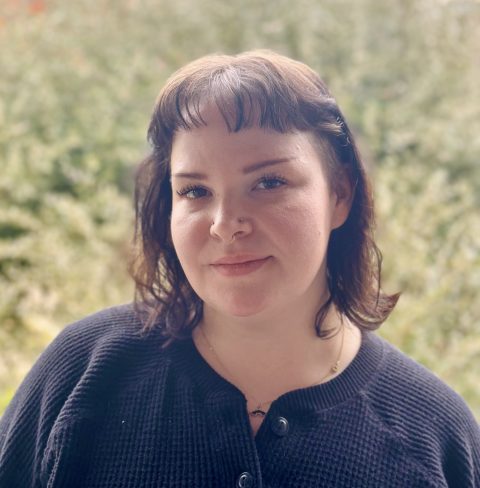
malia-pila

I like to think I’m a wordsmith. I can often take an idea and work to find the best words to tell a storymalia-pila I hope my young readers will love.
But a children’s book is way more than words. Beautiful illustrations are key to making well-written stories and turning them into visual magic for young readers.

Talented Native Hawaiian illustrator Malia Pila is one such magician. Her charming, gorgeous images have a cinematic aesthetic that young readers and their grownups love.

We are so pleased to talk story with Malia today.

Aloha e Malia! For those who haven’t met you, could you please tell us a little about yourself? 

My name is Malia Pila, and I’m an illustrator working primarily in picture books these days, but I have also worked in visual development for animation! I enjoy exploring different media and styles with my artwork whenever I can as well as researching niche things like historical costuming and the mythology of different cultures.

My biggest supporter for nearly 15 years now has been my (soon-to-be) husband. My career path has not been very clear or linear and even when I’ve had moments of self-doubt, he has always been at my side to help me back onto my feet and find inspiration again. 

Congratulations on your engagement! Where did you grow up? 

I grew up in a handful of different places. A large part of my childhood was spent between Hilo where my father is from and Kona, but we eventually moved to the mainland, and I spent my teen years in places like Florida and Arkansas.
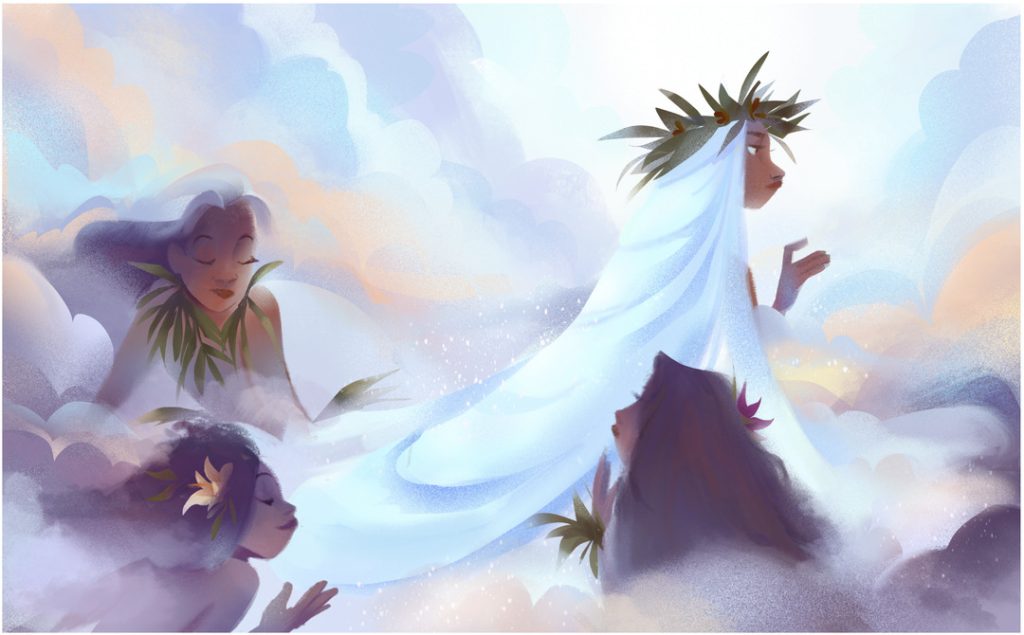
Poliahu
Illustration @ Malia Pila

What has been your journey to becoming a professional illustrator? Why did you become an illustrator/artist? Have you always wanted to create art? 

I have always had a desire to create art, but it took some time to land specifically on “professional illustrator.” My older sister introduced me to drawing when I was about 6, and while I’m sure I drew plenty before then, I specifically remember her introduction having a profound impact on me and igniting a spark that has just refused to die down since.

I’ve been lucky that my family has never put down my dreams or insisted I pivot to something else completely. So by the time I made it to university, I had refined an incredibly vague career plan of “ARTIST” into a more specific goal to work in the animation industry. I stuck with that ultimately, but I also found myself exposed to new things that really began to turn my head like illustrating for picture books and studying art history.

After university, I was left in a place I think a lot of fresh graduates are in after art school. There is so much uncertainty in many creative industries, so it can be overwhelming. I’ve tried to just focus on what makes me happy to create and that has really led me to where I am now.

What kinds of illustration work have you done? What do you enjoy most about illustrating, especially for a young audience? What are some of your greatest challenges? 

I enjoy illustrating for the sheer enjoyment of creating, to be honest. It is so fun to think of something that perhaps no one has ever thought of before or, alternatively, what many many people have thought of in very different ways, and see it put down on paper or canvas. When it comes to illustrating for a young audience specifically, what I love about it is trying to inspire the same thoughts and feelings I once had as a child looking at artwork in books or rummaging through different covers at the library.

That itself sort of becomes my greatest challenge, too. I want to convey so much with my art sometimes that I have to sit back and pick what to include so as not to overwhelm an individual illustration or muddy a concept and message.

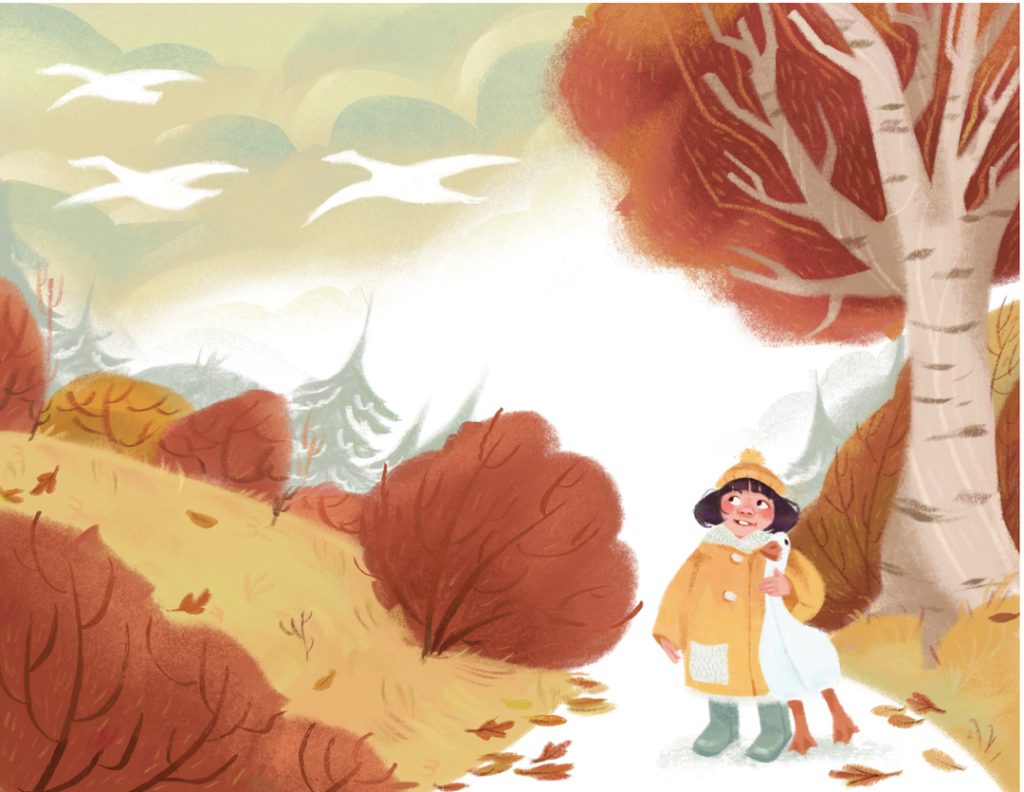
Fall-scene
Illustration @ Malia Pila

Do you have a favorite medium to work with? Why is that?

I recently picked up gouache painting again, and while I’m still refamiliarizing myself with the medium, I’d say it is becoming a new favorite. For the most part, I’ve worked primarily digitally as an illustrator until recently, and while I love all that digital work offers in the way of flexibility and ease, I really enjoy getting my hands back on something more tactile and messy like paints.

Can you share a bit about what you’re working on now? What’s your inspiration? 

Something that has always inspired me is my childhood growing up in Hawaiʻi. I have such fond memories of sitting on my grandpa’s lanai eating manapua, gawking at tide pools, and playing with sleeping grass as a kid. On the flip side, leaving all of that and moving to the mainland was incredibly difficult for me. I’m just starting out with the idea, but I’m hoping to play with it a little and see if these inspirations can come together as either a series of illustrations to speak on these experiences or, who knows, maybe even a picture book!

That sounds so fun! What are your hopes and dreams for the year and beyond in terms of your career and what you do you hope for your career in the future?

I’m starting 2025 with a lot of hopes! I recently signed with an agent so I’m looking forward to debuting on new books and other projects in the new year. My dream for the next year is to build a good foundation for myself as a professional illustrator and past that? I would love to explore the possibility of publishing a book as an author/illustrator myself. To be added alongside other published Pacific Islanders would be such a dream!

What advice would you give an aspiring illustrator?

It is okay to pivot. It is okay to take a break, too! I went through several years of my life when creating art was not a priority for me because I was dealing with some very difficult things. I felt bad about this for a while but honestly, a break was what I needed and I do not feel as if I irrevocably damaged my career by taking one as I eventually came back rested and reenergized and caught right back up to my peers. Sometimes taking a chance to sit back and take in other media can be so helpful when you’ve been creating endlessly for a while and feel burnt out.

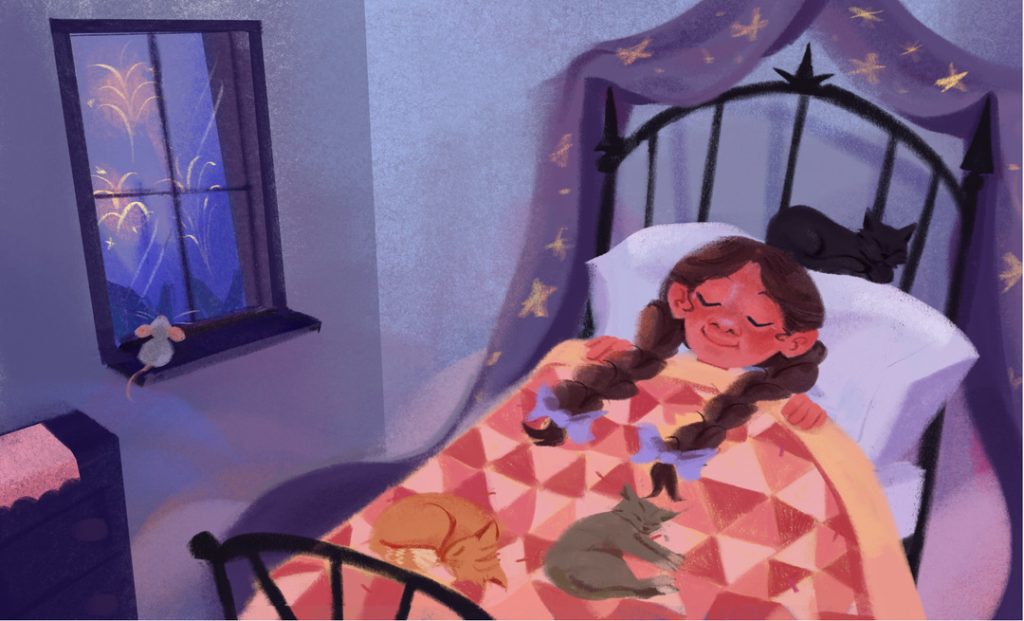
Sleeping
Illustration @ Malia Pila

What kinds of books do you enjoy reading? Any favorites?

I read a lot of historical fiction and some of my favorite books tend to fall into that category. 2024 was unfortunately a slow reading year for me but one of my favorites that I finished was The God of Endings by Jacqueline Holland.

I’m hoping to read so much more in 2025. Specifically, I want to focus on reading more books by other Pacific Islanders. In the past, I’ve found it a little difficult to track down titles but thanks to resources like Pacific Islanders in Publishing, I have a growing reading list to work through.

What’s your online presence? 

My portfolio website is maliapila.com. I’m a little more active these days on Instagram (or I try to be, anyway) and can be found there at maliapila.art. I welcome anyone that wants to chat or connect!

Mahalo nui, Malia, for talking story with us! We’re looking forward to hearing more from you soon! To learn more about Malia and see her wonderful illustrations, visit her website, Malia Pila.com, and follow her on Instagram at maliapila.art. Malia is represented by James McGowan at BookEnds Literary Agency.

Images courtesy of Malia Pila.

Book Review: Tala Learns to Siva

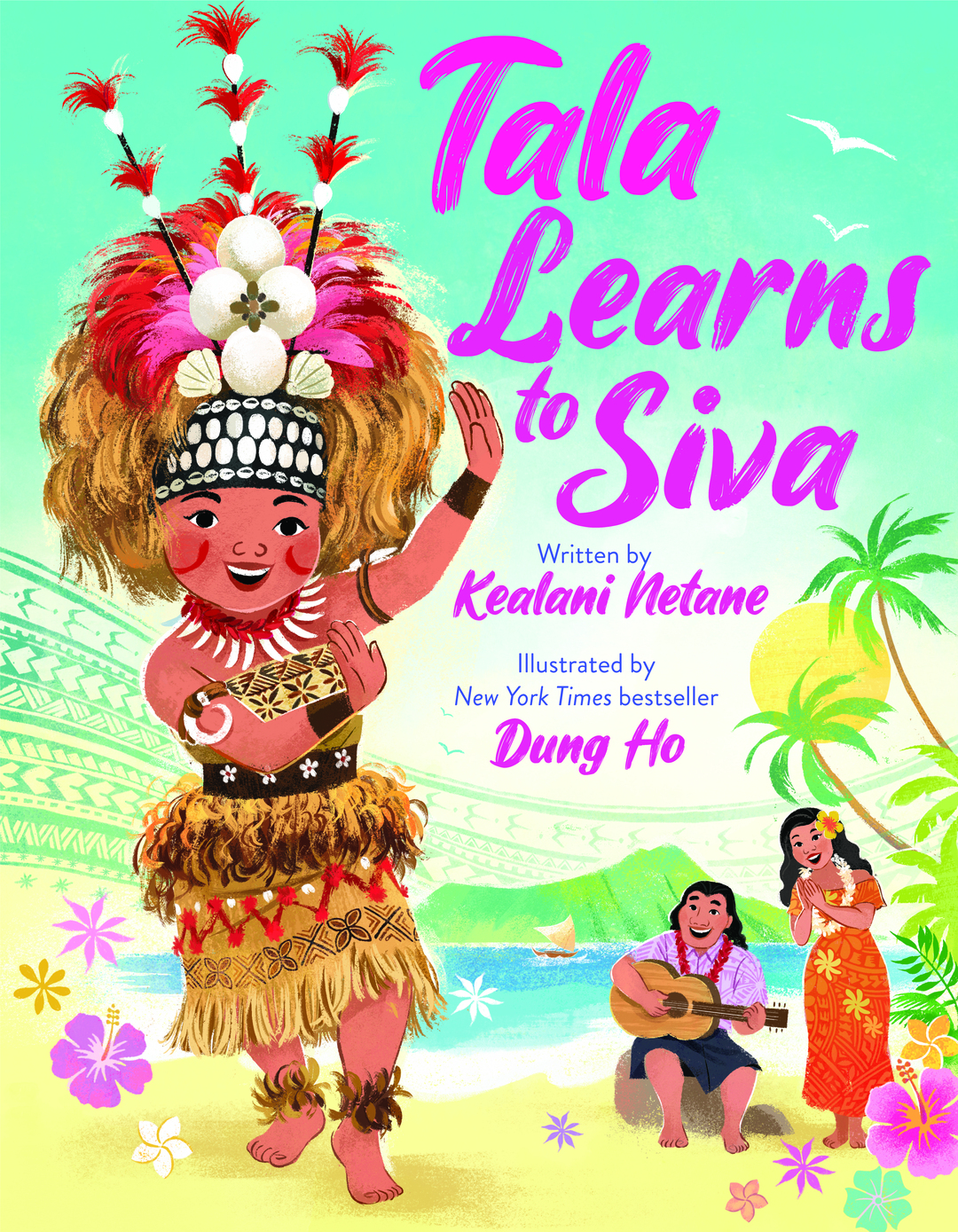
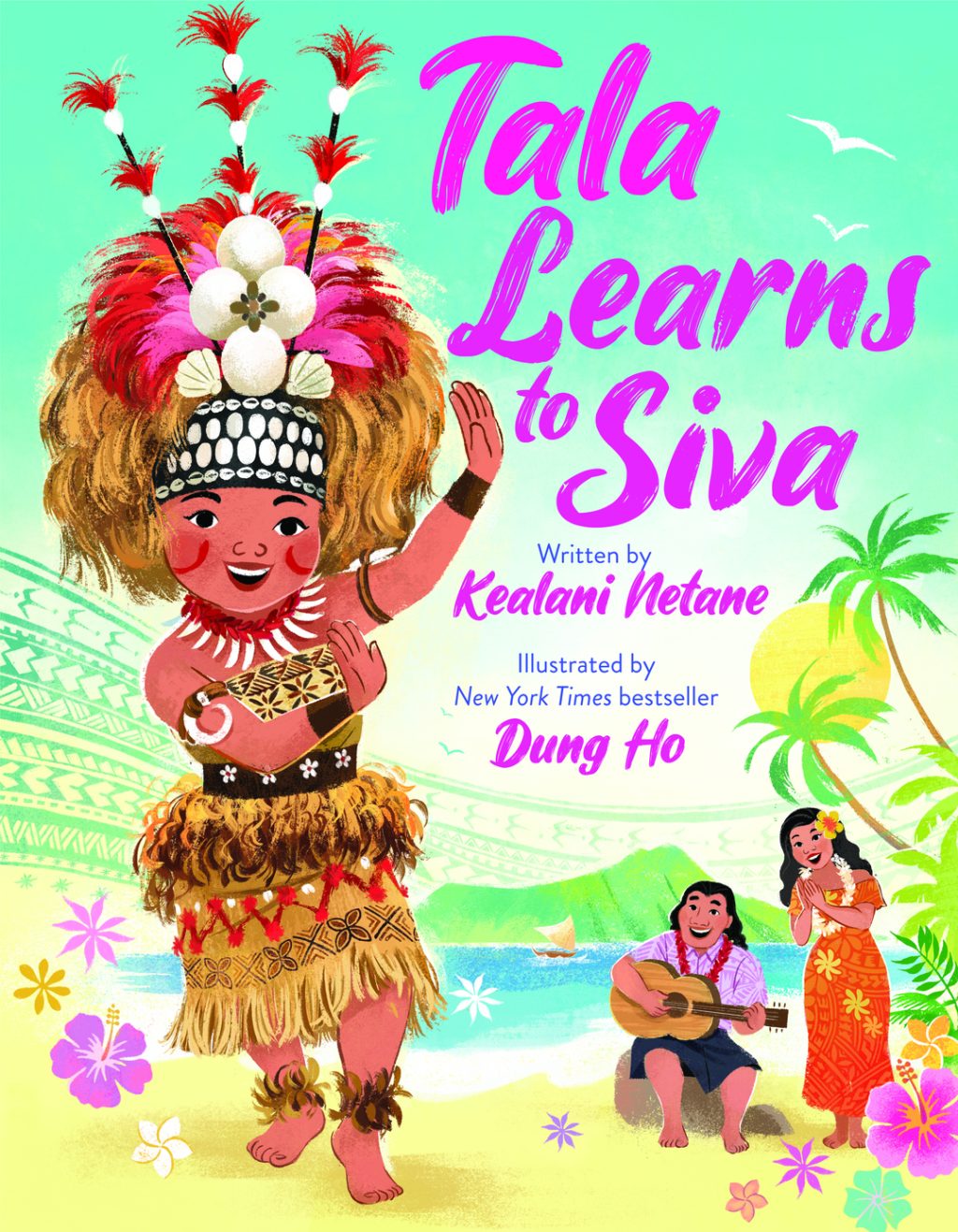
Cover

There’s something magical about children’s books written by Native Hawaiian and Pacific Island authors.

Until recently, stories about our communities told by our people were largely missing in children’s literature. Thankfully, the times are changing, and more voices are emerging to tell our own stories. The best of these narratives sing with heart and authenticity that comes from being rooted in the community.

Tala Learns to Siva is one of those stories. This delightful Pacific Island story by talented author Kealani Netane deserves a space not just on a child’s bookshelf but on school library shelves everywhere. 

Cover
Illustration @ Dung Ho from Tala Learns to Siva by Kealani Netane (Scholastic/Orchard Books, 2024)

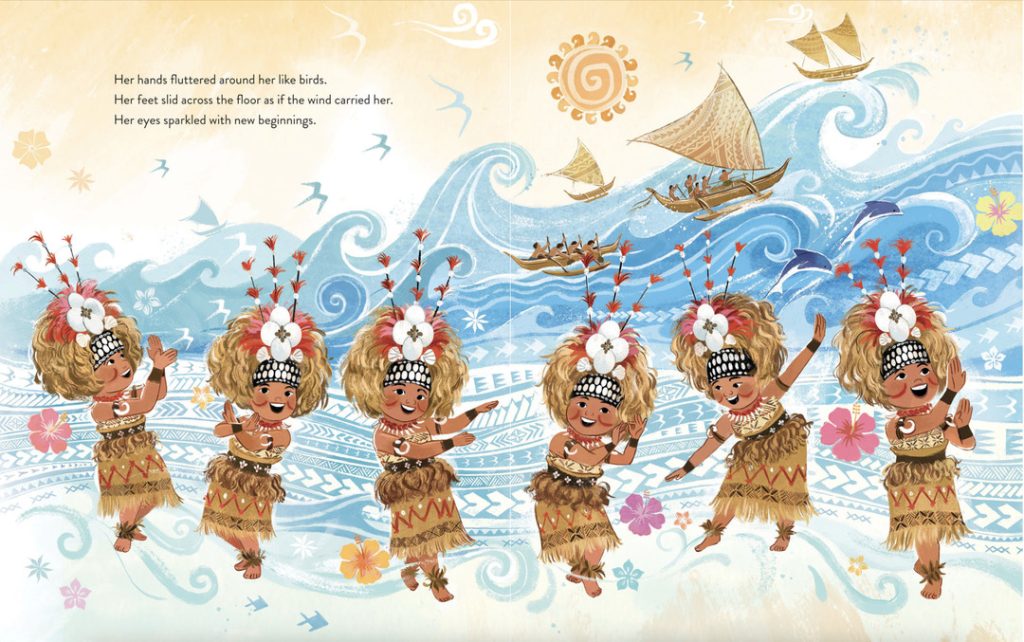
Young Tala watches her Aunty Siva perform the traditional Samoan taualuga. Captivated by her aunt’s grace and beauty, Tala asks her to teach her to dance in time for her grandmother’s birthday party. But as with most things worth learning, what at first seems easy actually takes work and practice. Will Tala learn to dance in time to share her siva with her grandmother? She decides to do her best.

Like all good stories for children, Tala Learns to Siva resonates with young readers everywhere. They will easily relate to the universal story of the young protagonist’s determination to overcome her doubts and fears. Tala practices everywhere she goes and works hard to master the hand and foot movements. But it’s when Tala understands that the dance connects her to her ancestors that she truly begins to shine.

Tala-and-Family
Illustration @ Dung Ho from Tala Learns to Siva by Kealani Netane (Scholastic/Orchard Books, 2024)

The illustrations by New York Times bestselling illustrator Dung Ho are colorful and vibrant. The art beautifully invites the reader to become a part of Tala’s island family.

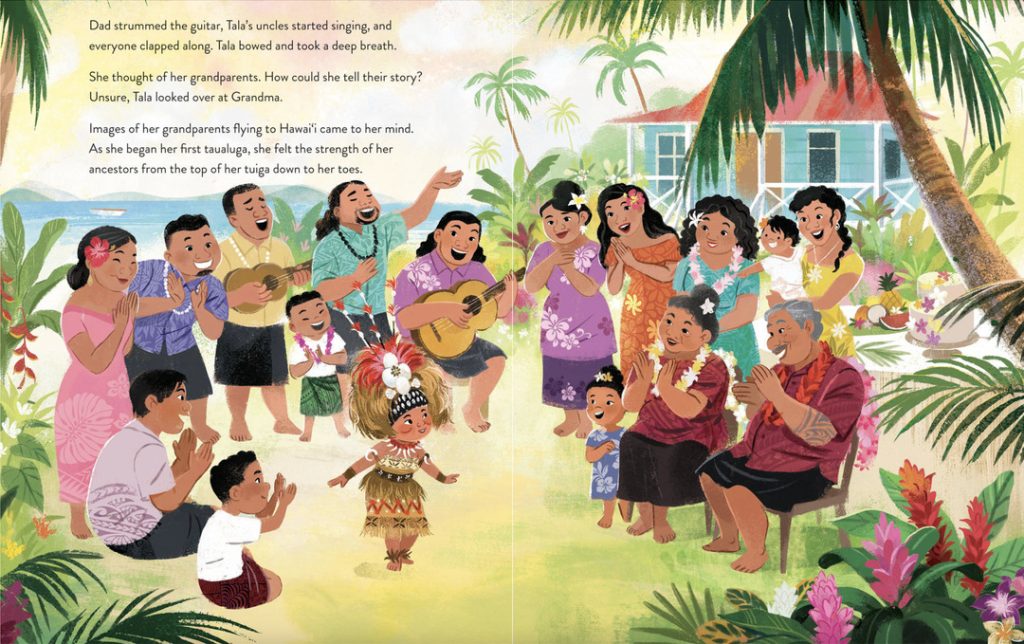
Two spreads are my particular favorites. I love the dance spread on pages 20–21. Both text and art do a wonderful job of capturing Tala’s joy and triumph as she dances the taualuga solo for her family and friends. 

And I especially adore the family’s reaction to Tala’s solo on page 22. Growing up in Hawai’i, I’ve attended many Samoan parties and celebrations, and they often end just as page 22 so effectively shows, with elders and others joining in on the fun. This page is my very favorite, I think, because it speaks to me personally, because these folks could be my own friends and neighbors. And isn’t being able to relate to a character or to a piece of art what makes a book special?

Tala-dances-solo
Illustration @ Dung Ho from Tala Learns to Siva by Kealani Netane (Scholastic/Orchard Books, 2024)

The back matter includes a glossary of terms and an author’s note. In it Kealani expresses her love for Samoan dance and traditions that she gratefully passes on to her children.

Tala Learns to Siva is a wonderful introduction to Pacific Island culture and a most worthy addition to any bookshelf.

Tala Learns to Siva
Written by Kealani Netane, illustrated by Dung Ho
Orchard Books, an imprint of Scholastic Books, 2024
ISBN 978–1338859317
Suggested for ages 4 — 8 

Meet author Kealani Netane in our talk story interview! 

Please read our disclaimer to learn our book review policy. Mahalo!

Galley review copy and images courtesy of Kealani Netane.