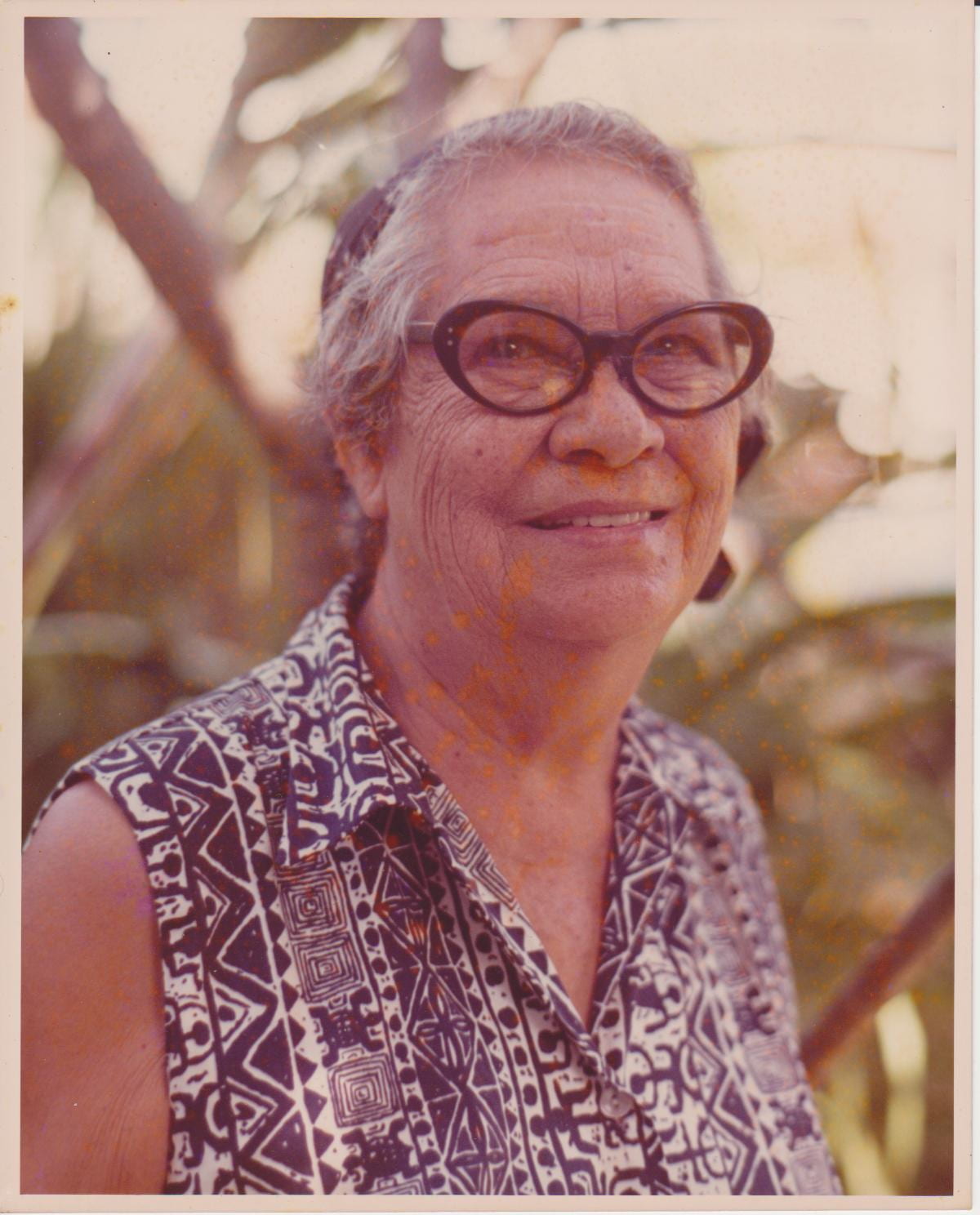
Some of my favorite popular posts when I published Pūpū A ‘O ‘Ewa Native Hawaiian Writing and Arts at Leeward Community College were personal essays by students and faculty.
Fishing for Grandma, by my colleague and longtime friend, Dave Ka’apuwai “Manu” Bird, was first published in 2014. About this essay, one of our readers wrote, “I especially loved reading Manu’s narrative…brought back some memories with my own ʻohana!” I know that in sharing his story, Manu was glad that someone else connected to their own kupuna.
Manu joined his ancestors earlier this year after a brief illness. He leaves behind his loving family — wife Mary, son Keoni, daughters Mālia and Tinan, and moʻopuna — as well as his many students, colleagues, and friends. E Manu-Tok, nui ke aloha ia ʻoe.
Watch our video interview with Manu Bird.
Fishing for Grandma by Dave Manu Bird
“Goddam dis buggah!” I exclaimed as the kūkū of the pua hilahila dug into my hand. Like the entire old cemetery beside the Waikāne Congregational Church, the grave I was cleaning was infested with the thorny plants.
“Please remember where you are,” Mary scolded, taking umbrage with my profane language.
“How can forget?” I shot back.
“Well, if you cannot respect God, you could at least respect the dead.”
“So?” I muttered to myself. “Stay make da kine make guys anyway.” With that, I knew that I was getting stink eye from my wife.
My sarcasm was the result of stress, not how I felt. As I surveyed the graves around me, I still couldn’t believe that Grandma was gone. Her death still didn’t seem real. What was real, however, was the pain of the kūkū poking my knees through my jeans. Once again I bent over, carefully pushed my fingers under the branches of another pua hilahila plant, pinched its stem tightly, and yanked the whole thing out of the ground by its long tap root. I threw the plant on a nearby ‘ōpala pile and reached for another.
It was hot, and I was sweating, but as I worked I could not help but remember Grandma’s voice even though it had been physically stilled forever. I couldn’t help but think how much Mary and Grandma often sounded alike. They both usually spoke that crisp English locals always speak when they don’t want to sound local. They e‑nun-ci-ate care-ful-ly.
“When are we going?” 13 year-old Keoni whined, pulling me out of my reminiscing. He was bored and wanted to get on with our picnic and fishing expedition to Kahana Bay, our destination after the graveyard.
“‘E Keoni, kulikuli, ‘eh,” I responded.
I didn’t need a punk kid’s hassles adding to my misery. I was wilting because of the heat, the kūkū, and the complaints. I was also getting tired of the general uneasiness I felt because only Mary, Keoni, Mālia, Tinan, and I were there at the graveyard. It did not seem right to me that only our nuclear family was taking part in Grandma’s post-funeral funeral without representatives from the extended family, even though no-one else was able to join us.
Grandma’s formal funeral had been held the month before. Family members had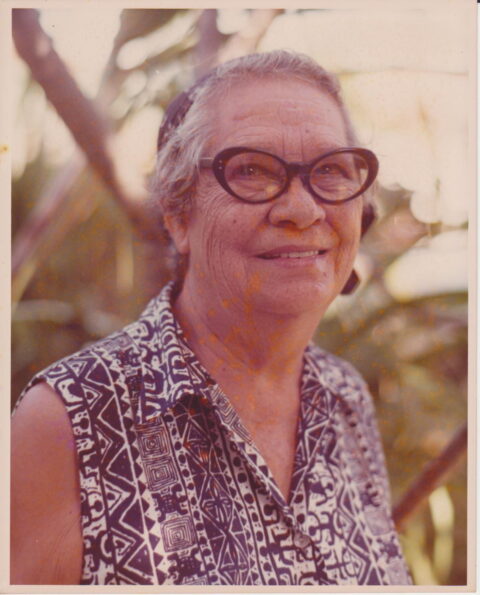 gathered together from Kaʻimukī, Kailua, Kāne’ohe, Nānākuli, and the Mainland. That day, we scattered most of Grandma’s ashes along with thousands of flowers and prayers off of Kahala Beach Park. We gave Grandma back to her beloved moana and ‘āina at that place because it had been one of her favorite fishing spots, at least in the days when Kahala consisted of groves of kiawe trees, a dairy farm, and a hodgepodge of week-end beach cottages. Before the main funeral started, Mary and I put a kapu on a little bit of Grandma. We wanted to bring a part of her to the windward side, another of her favorite fishing areas. That day in Waikāne, we had two film canisters filled with Grandma’s ashes, all that was left of her in this world.
Finally we could read the inscription on the grave headstone that I was cleaning:
Martha Koolau
Died Dec 10, 1931
Age 50 Years
Martha Ko’olau was Grandma’s mother; Grandma had lived to be 92.
My cleaning work finished, I stood and stretched. One of the kids retrieved a discarded pua hilahila and used it to brush the dirt off of the gravestone.
I suddenly felt strangely light-headed and absent minded. “Pau dis,” I said. “Mu fek ea nunuw nga. . . I mean time for da lei and stuffs.”
Without thinking, I had momentarily switched into our hānai daughter’s native language. Then as I looked down at the grave, it struck me how kapakahi we all were – and are. We are like cultural schizophrenics who switch personae seemingly without reason. We were exactly like what Grandma had been. For years I tried to understand Grandma, the last family member born in the 19th Century and the only one we knew who had seen, talked to, and had even sung for Queen Lili’uokalani. But Grandma had been like a mo’o that changes its colors. She was hard to see because she blended in with her immediate surroundings. She never told us very much about herself. She was excessively reticent about her childhood and early adult life. She never talked about her mother. So what about us?
My sudden question was a revelation. If Grandma was an enigma, then so are we. Who was Grandma? By extension, who are we?
Mary and the girls began laying lei, flowers, and lā’ī around the headstone. As they did, I looked out at the vehicles roaring past on Kamehameha Highway a few yards from us. The sight of the cars pulled my thoughts back to long ago when we were traveling down the same road …
… Has it really been 20 years since we passed here in Mom Z’s old Chevy II station wagon? We were headed for Uncle AP and Auntie Sam’s beach house in Ka’a’awa for a week’s worth of fishing and swimming, a mid-summer break and the ‘oama season we always looked forward to. Grandma’s voice and Grandma’s words that day are still as clear to me now as a Kāne’ohe Bay reef when there’s no run-off pollution to silt the water. She was scolding me.
Auntie is stupid. You are stupid for letting her make you take these bananas. I would never have gotten in the car if I had seen them. You never take bananas and manure to the beach. When you “ go to the mountains,” you must do things properly.
I no like take kūkae no place, especially holoholo.
Boy, no tok lai’ dat! Speak pro-per Eng-lish .…
That was vintage Grandma. Rarely, though, did she raise her voice like this to me or her other mo’opuna. She didn’t have to. She never touched us, but she could whack us aside the head with a withering look if we did something that displeased her or violated her sense of propriety. To this day, she is alive. I know so. I can no longer give her a hug or kiss her on her velvety cheek, but there is little I do unless beforehand I ask myself If I do this, would Grandma’s maka smile at me or give me stink eye?
But who was this woman? And by extension, who are we?
Occasionally Grandma would pass on to us snippets of Hawaiian lore and protocol, especially about fishing – her life-long passion. But what about the rest of the mana’o she had gathered during the course of her long life? What about growing up in rural Puna, attending Saint Andrew’s Priory as a boarding student, and singing on the Hawaii Calls radio program in the 1930s and 1940s? What adventures did she have? Whom did she know? Why could she understand spoken Hawaiian but not put two words of the language together to speak it?
As I stood by the grave watching Mary and the kids arrange the lei, I could only speculate. She was not atypical for her generation or the next in her reticence. Could the effects of 1893 have silenced them all? Hawai’i was once one of the most literate nations on earth with an active Hawaiian language publishing industry and citizens who were avid readers and writers. In 1896, the haole leaders of the Republic of Hawai’i passed a law banning Hawaiian as a language of instruction in schools, a law that was not repealed until 1983. Teachers physically beat children if they spoke Hawaiian, and teachers visited their students’ homes and scolded their parents for speaking Hawaiian in front of their children. The Hawaiian language almost went the way of Latin. Were these the reasons for generations of kūpuna silence?
Who was Grandma, a person who was born in Old Hawai’i but who died in Modern America? Who was this person who worked as a faithful cashier at the original Willows restaurant in Mo’ili’ili for decades until she was in her 70s? She had a strong American work ethic, but still she would occasionally drink Scotch before work or call in sick to go fishing. What caused her to be kolohe?
And who are we? As we stood by the gravesite, I could not help but wonder what perspectives we no longer understood and probably never would because of Grandma’s silence. I felt like we were already at Kahana Bay, trying to catch fish in depleted and degraded waters.
Mary brought me back into reality, for the ho’okupu was in place. We stood around the grave holding hands over a prayer, and then we took turns sprinkling Grandma’s remaining ashes over her mother’s grave. We knew that eventually the life-giving ua would soak her remains into the sacred ‘āina, mingling her with her mother’s iwi and binding us once again to the long line of kūpuna and ‘aumakua that stretches back into antiquity.
After we finished scattering Grandma’s ashes, we once again joined hands for pule. “E ko mākou makua i loko o ka lani,” Mary began to intone. But just then a long line of tourist buses heading for the Polynesian Cultural Center roared past 15 feet from us, drowning out Mary’s words. The buses’ diesel engines blasted us with storms of blue-black exhaust and silenced our prayer to Grandma and to God.

 week with my friend, author Brandi-Ann Uyemura. Writing coach, blogger, coach and author, Brandi does it all. Her articles and essays inspire hope, courage and compassion. An Asian American who grew up in Hawaiʻi, Brandi brings a much needed authentic voice, not just for Asian kids in Hawaiʻi but for all kids, everywhere.