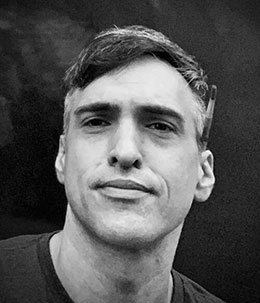
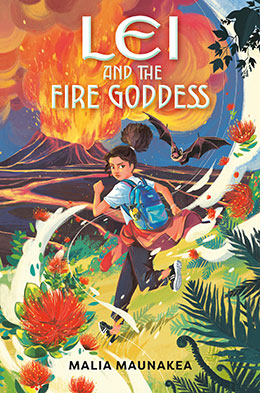
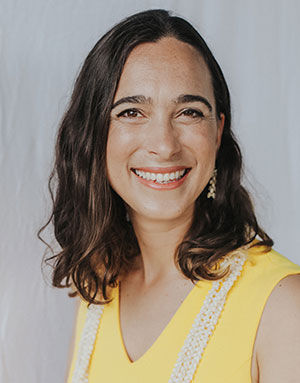
 Malia Maunkea is Native Hawaiian author of middle grade and non-fiction. Her new novel, LEI AND THE FIRE GODDESS, a rollicking story about an adventurous Native Hawaiian twelve-year-old, is a rarity in childrenʻs literature: a story for middle grade kids written by an ʻōiwi author that features an ʻōiwi character. We are proud to feature Malia in todayʻs talk-story.
Hoʻomaikaʻiʻana on your new novel! For those who haven’t met you yet, please tell us a little about yourself.
Sure! My name’s Malia, named for the Olomana song O Malia since my parents’ first date was to an Olomana concert. My mom is from upstate New York and is pure Polish. My dad is from Māʻili (West Side) on Oʻahu. I’ve been married to my awesome partner for nearly two decades, and we have two kids who are teens at the time of this interview. I love hiking and backpacking and traveling around the continent in our tiny campervan.
Where did you grow up? What high school did you grad from?
I grew up on Hawaiʻi Island ’til 7th grade and Oʻahu thru high school. I got accepted into Kamehameha Schools in 7th grade. I was a boarder for one year, then my family moved over to Oʻahu and, much to my dismay, I had to move back in with them. I graduated from Kamehameha Schools in 1999. My dad is class of ʻ72. My great-grandpa is class of ʻ17.
I mua! Go Warriors! Can you share a bit of your upcoming debut novel, LEI AND THE FIRE GODDESS? Without giving too much away, what is it about?
 LEI is about a girl who is raised in Colorado but goes to stay with her tūtū in Volcano, Hawaiʻi every summer for three weeks. She’s part Hawaiian but doesn’t feel like she’s Hawaiian enough to fit in there, and she also struggles fitting in back home in Colorado where no one believes the things her grandma tells her.
This summer she decides she doesn’t believe them either, and all she wants to do is go do touristy things so she can have fun stories to tell her friends when she gets home. Unfortunately, Lei ends up insulting Pele, the fire goddess, who sends her giant hawk to kidnap her best friend. When Lei goes to rescue him, she realizes just how real Tūtū’s moʻolelo are as she teams up with demigods and talking bats to battle mythical creatures and evade the traps Pele hurls her way. For if Lei hopes to get her friend back, she has to dig deep into her Hawaiian roots and embrace all of who she is.
That’s an exciting idea! What inspired you to choose that topic for your debut novel?
My son was big into Greek mythology for a while, and I tried explaining to him that we Hawaiians have our own amazing gods and legends, but he sorta brushed me off. I decided the only way I could get him to listen was maybe if I put it in a book that could be on a shelf that his classmates might pick up and read, like a Percy Jackson type story. So I came up with this story to try share a lot of the myths and moʻolelo I learned growing up in Hawaii with a new generation of readers who may or may not be familiar with our stories.
What was your favorite part of writing your novel? What was most challenging?
My favorite part was going back through my memories and pictures from living in Volcano and visiting Hawaiʻi Volcanoes National Park and remembering all the iconic art and songs that I was able to thread throughout the story. The most challenging was bringing it up to speed. Things have changed since I moved from the island, and I wanted to make sure I was still on point with various landmarks and understandings.
What characteristics do you love best about your protagonist, Anna Leilani Kamaʻehu? Is she modeled after someone specific?
I love that she’s sort of a jump-right-in-and-figure-it-out-as-we-go kind of a person. I pulled a lot of my own struggles of not feeling Hawaiian enough and difficulties making and keeping friends as material for Anna.
What was the journey to getting your novel published like? How long did it take to write your book?
I drafted this book from April to August of 2020 then spent two years in revisions. My journey was super fast compared to some folks, and not as fast as others.
In the fall of 2020 I applied for a number of mentorships and ended up being selected for both We Need Diverse Books (WNDB) and my regional Society of Children’s Book Writers and Illustrators (SCBWI) programs. I worked intensively with Alan Gratz and Andrea Wang to rewrite, revise, and improve my story from January to May of 2021, then submitted it to #APIPit (a pitch event on Twitter) in May of 2021. I received interest from a number of agents, so I sent out my queries and interviewed different agents, selected an agent, did more revisions, sent the book out on submission to publishers in June, ended up having multiple publishing houses interested and went to auction in August.
We sold in September 2021 in a two book deal and started working with my fabulous editor Elizabeth Lee at Penguin Workshop (an imprint of Penguin Random House). So since then it has been many more rounds of revisions, and now working on book two!
Why did you become author? Have you always wanted to be an author?
I loved writing when I was young but was advised by teachers that it wasn’t necessarily my strong suit and that I was better at the maths and sciences. I also loved reading but abhorred book reports and most of the required reading from my classes. It wasn’t until I was an adult with a couple of careers under my belt when I popped my head up from the grind and wondered if it was possible for me to try writing again.
We are so glad you did. What do you enjoy most about writing, especially for kids? What are some of your greatest challenges?
I love writing exciting, fast-paced action scenes—showing kids how clever and strong and brave they can be. My greatest challenge is to get the characters to have an arc, to have them change over the course of the story. A mentor told me once that people don’t fall in love with plot; they fall in love with characters. The character needs to be three dimensional and flawed, so readers can root for them and understand why they’re going through what they’re going through. That is challenging for me as I usually come up with fun circumstances that I want to have happen to my character, but they usually don’t tie in to a theme or deeper meaning (which probably ties into why I struggled with Language Arts and book reports in school.)
You also wrote another book, BACKPACKING WITH CHILDREN book, which is on a very different topic. What made you decide to write this book?
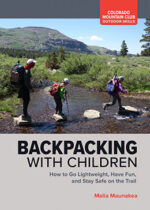 I actually started that one before LEI AND THE FIRE GODDESS. A friend of mine published a book for beginner backpackers, and I thought that if he could do it, I could do it. They say to “write what you know,” so I wrote about my experiences backpacking with our kids over the past ten years and 600+ miles. While that book was on submission, I had a lot of time to wait, and so I decided to write the next thing, and the next thing, and then another thing. And that last thing ended up becoming LEI!
What are your hopes and dreams for the year and beyond in terms of your publishing career and what you would like to see published in the future?
I have so many ideas and not enough time! I’m working on revising the sequel for LEI right now and working on a young adult contemporary novel that I describe as Pride and Prejudice meets WILD. I’d love to do well enough that I’m able to get back to Hawaiʻi and spend time with keiki in the schools there.
Hopes and dreams? How big you want to know? Heck, if we go big time, I’d love for someone like Dwayne Johnson or Jason Momoa or Barack Obama to pick it up (they all have daughters and probably other kids that they could gift it to after they’re pau reading) and talk about it so that it gets on the radar of Taika Waititi and scooped up into a movie. Then some mysterious benefactor who is looking to give back to kānaka in Hawaiʻi offers to give a copy to every kid in Hawaiʻi (so many times growing up I never had money to get a book at those book fairs) and rents out the movie theaters so all the kids and their families can go see it for free.
Clearly I’m not realistic when it comes down to the fact that this is a business since I want to just give it all away. I’d absolutely love to have a long, steady career in writing, but even if LEI is the only fiction book I ever sell, it’ll have been an incredible experience.
I love your big dreams, Malia. What beliefs are your work challenging?
I’m not sure if this is challenging beliefs, necessarily, but I’m trying to do a couple things with this story:
- Help kids who might not feel like they are representative of their own cultures or ethnicities understand that they are enough and
- Help increase awareness of some of the issues Hawaiians are facing in an age appropriate way that doesn’t feel overly teachy/preachy— mentioning the day the Hawaiian flag was taken down from ‘Iolani Palace, by mentioning the telescopes on Maunakea and protection efforts there, having Anna face discrimination by a local girl when she doesn’t pick the right sticky rice at the grocery store.
Do you have any experiences as a Native Hawaiian writer that you might share with our readers? What would you like to see change in the industry regarding the acceptance of BIPOC creators?
Our voices are so important! The way we view the world, interact with nature and our families, process trauma, and perhaps come from a more collectivist culture (prioritizing the group above the individual) are all so different than experiences traditionally portrayed in stories.
Some of us don’t follow traditional western storytelling patterns, and that’s okay! I’m really excited about some new up and coming Kanaka authors, like Makana Yamamoto’s Hammajang Luck and Megan Kakimoto’s Every Drop Is A Man’s Nightmare and your own Kahoʻolawe! All of our stories are important, and it’s necessary for a plethora of us to have our voices out there so none of us is burdened with representing the entire lāhui, the entire Native Hawaiian population. We are each so unique within our shared experiences, it is critical that readers are able to see Hawaiians as individual flavors, not just all coconut all the time.
What advice would you give an aspiring writer?
Find other writers to learn with, practice with, and commiserate with! If you love it, it isn’t a waste of time. If your strengths lie elsewhere, you can do both! Keep this as a hobby as you explore other things as well.
Is there a fun fact youʻd like to share about yourself with young readers?
Hmm, one of my earlobes is attached, and the other isn’t. Oh, and I have a preauricular pit on one ear. And I get random songs stuck in my head a lot of times and end up making epic mash ups of songs but can never remember any of them. Otherwise, I’d have been an awesome DJ.
What kinds of books do you enjoy reading? Any favorites?
As a kid I loved Garfield and The Far Side (I probably would have devoured graphic novels if they’d been around!). Then I got into creepier things, RL Stine to Christopher Pike to Stephen King (it was quite the jump, but there weren’t many young adult options that I knew of way back in the 1900s). Now I love reading funny, action-packed middle grade stories and young adult or adult rom-coms with strong female leads and lots of witty banter. I go through them too quickly to remember a favorite!
Do you have an online presence? Do your readers contact you? What do they say?
My website is MaliaMaunakea.com, and on social media I’m on Instagram and Facebook. My book wasn’t out then, but I did some virtual classroom visits in February and read a couple chapters of my book to kids, and a number of the classes sent me thank you notes. Oh, my goodness, my heart was not prepared for the sweetness and loveliness of their expressions. They are why writing for kids is the best thing ever.
It was so much fun talking story with you, Malia! Mahalo nui loa for sharing your mana’o with us! E pili mau nā pōmaikaʻi me ʻoe (best wishes!)
To read more about Malia, including her cool list of fun facts, visit her website, MaliaMaunakea.com. Photo credit: Kahiki Photography