Book Review: Too Many Mangoes, by Tammy Paikai

Too_many_mangoes

Too_many_mangoes

Some picture books are classics. They tell timeless tales that teach us about the world and our place in it.

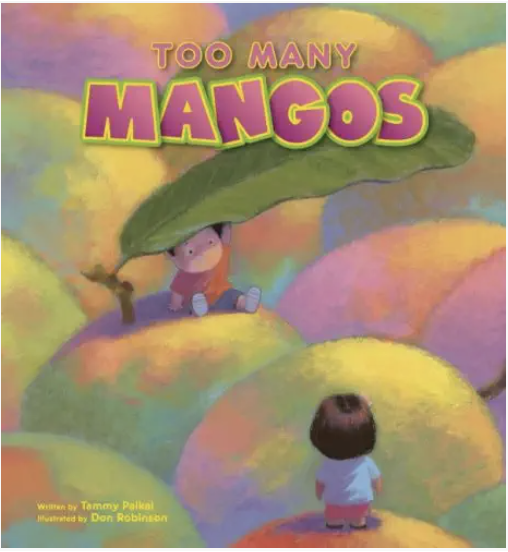
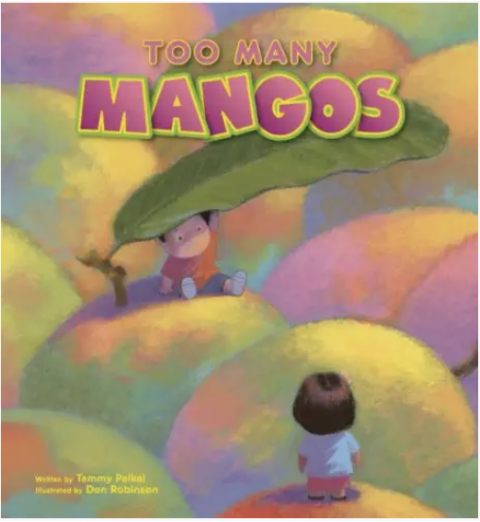
One such classic also happens to be one of the first Native Hawaiian-themed books written in an authentic voice. Too Many Mangoes by Tammy Paikai is a story based on the author’s childhood experience.

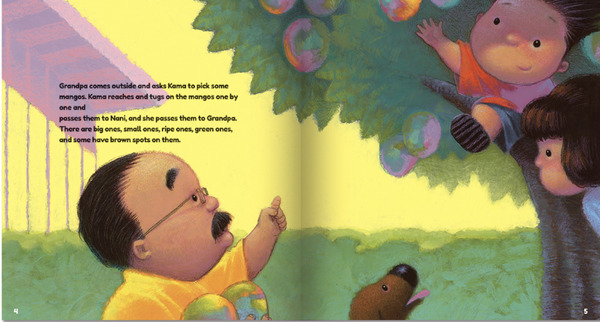
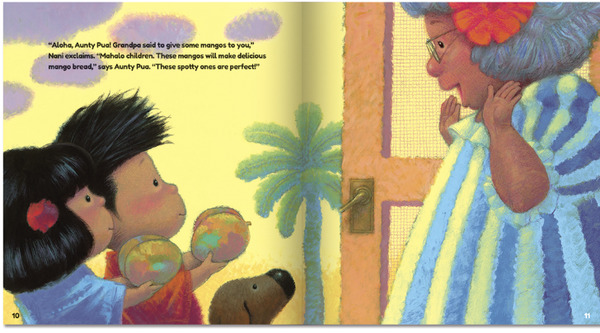
This gentle story is about two Hawaiian kids, Kama and Nani, who love to climb the mango tree at their grandpaʻs house. One day grandpa asks them to pick some mangoes, but when he realizes that the kids have picked way too many for their family to eat, he instructs them to give the mangoes away to their neighbors.

Thus the adventure begins. We are introduced to a delightful community of generous and kind neighbors. The kids go to each house to share the mangoes and, in return, are given wonderful treats — baked goods, fruit, jam, even an orchid plant — that the book calls “mahalo gifts.” The last spread is at the table where grandpa and the grandkids are happily feasting on their unexpected bounty.

Too-many-Mangoes-Grandpa
Illustration © Don Robinson from Too Many Mangoes by Tammy Paikai (Island Heritage, 2009)

What I love most about this book is the Native Hawaiian lessons of sharing without expectation of anything in return and in being happy with what nature gives you. Kids can be picky eaters, and this story shows then that delicious produce doesn’t have to be blemish-free: mangoes donʻt have to be perfect to be, well, perfect. As the neighbors explain, overripe mango can be sprinkled with sweet-and-salty li hing powder or made into pickles or bread. I was delighted to find that my favorite way to eat slightly underripe mango — with a thin marinade of shoyu, vinegar and chili pepper water — was featured in the book.

Illustration © Don Robinson from Too Many Mangoes by Tammy Paikai (Island Heritage, 2009)

Too Many Mangoes offers many enrichment opportunities and has been adapted by teachers, librarians and parents in curriculum for first graders, including math, food and backyard agriculture, and culture and diversity. The book has been adapted into classroom plays and reader theaters and community read-aloud events.

The illustrations, by popular local Hawaiʻi illustrator Don Robinson, are gorgeous, with muted tropical vibes youʻd expect from a children’s book about Hawaiʻi.

Some book reviewers have made an issue about so-called grammar errors. I found just one spread toward the end of the book where the tense shifts from the present to the past then back to the present. More a stylistic hiccup than a grammar mistake, the shift in tense is minor and does not detract from the story.

Perhaps the best vindication is that Too Many Mangoes was a featured title by the Harvard University Graduate School of Education. Dr. Sarah Dryden-Peterson described the Books of Belonging program “where we find big, hard questions about the world packaged with love between the covers of a book.”

And that describes Too Many Mangoes perfectly.

Too Many Mangoes, A Story about Sharing
Written by Tammy Paikai. Illustrated by Don Robinson
Island Heritage Publishing, 2009
ISBN 1–59700-758–7
Suggested for ages 2–6

Meet author Tammy Paikai in our talk-story interview and discover her other Hawaii-themed picture books. Too Many Mangoes is available at Native Books Hawaiʻi and at your favorite online booksellers. 

Images from Welcome to the Islands. Please read our disclaimer to learn our book review policy. Mahalo!

Book Review: Hiʻiaka and Panaʻewa, a Graphic Novel by Gabrielle Ahuliʻi

Hiʻiaka-and-Panaewa

Hiʻiaka-and-Panaewa

When I was a kid, I had a set of books called Great Illustrated Classics. They were fat volumes full of stories embellished with black and white drawings. The scariest tales were from Greek and Roman mythology where the hero battled bad guys and won (most of the time.) 

Even in school, the myths we read were limited to Greek and Roman gods with names like Zeus, Athena, Poseidon and Mars.

But where were the colorful picture books about Pele, Maui, Kaʻahupahau, Kamapuaʻa, the menehune? There weren’t any, not in the kidlit section of the library or in any of the illustrated classics that lined my childhood bookshelf.

The message native kids like me got loud and clear was that those Greeks and Romans were the classic heroes, the only heroes worth learning about.

Thankfully, times are changing. More Native Hawaiian authors and artists are revisiting and retelling our traditional stories for today’s young audiences.

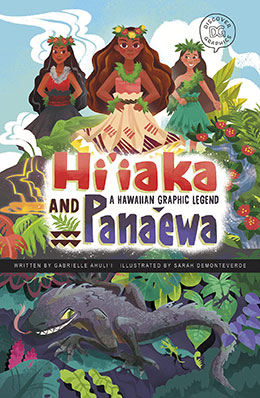
The latest is a graphic novel, Hiʻiaka and Panaʻewa, by Native Hawaiian author Gabrielle Ahuliʻi. Intended for the picture book crowd, ages 4 – 8, and their grown-ups, this book is the perfect introduction to Hawaiian myths for the youngest readers.

The story, as described in the summary, is: 

Hiʻiaka wants to make the forests of Hawaiʻi safe for people. But sheʻll have to battle an evil lizard named Panaʻewa and his army to do it. With a little help from her sister, her friend, and some special powers, sheʻs ready for a great battle.”

This is a story of friendship and sisterhood. Faced with the task of keeping the forest safe for the people, Hiʻiaka, accompanied by her friend Wahineʻōmaʻo, must decide how to challenge the fearsome guardian mo’o, Panaʻewa.

In one of my favorite scenes, Hiʻiaka seeks strength by looking up at the stars and remembering the courage it took for her ancestors to brave the vast Pacific Ocean to settle in Hawaiʻi. This simple panel conveys such emotion in a deeply Hawaiian way.

The small cast of characters are totally likeable. They experience some fears and doubts, but ultimately they find strength from within and from each other. The battle with Panaʻewa is scary, but the scene is not too intense for young readers.

As expected in a children’s story, the heroes prevail, and the end is hopeful. The last panel neatly ties up the story by reflecting the very first panel of the island below and the manuokū flying above.

I appreciate that the story is presented as a short (32 page) graphic novel. The format with its thoughtful word choice and poetic devices is perfect for its intended audience of beginning readers but also as a read aloud.

The illustrations are intentionally sparse. Kids can easily get overwhelmed in traditional comic book style, but in this book, frantic, overdrawn panels are avoided. Instead, the colorful, picture book-like illustrations convey both story and emotion appropriate for the intended age group.

More than anything, I love the author’s authentic voice. Everything, from imagery – especially Pele’s skirt and lei, the voyaging canoe, the manuokū seabird, the moʻo – to the selected words in ʻōlelo Hawaiʻi feels pono. For traditionalists in my community, this story of Pele and Hiʻiaka is respectful.

The bookʻs back matter consists of helpful resources, including writing prompts, discussion questions, and a short glossary.

In her author’s note, Ahuliʻi writes, “I hope our ancestors look on my telling with pride.”

I am sure they are.

Hiʻiaka and Panaewa, A Hawaiian Graphic Legend
Written by Gabrielle Ahuliʻi. Illustrated by Sarah Demonteverde
Published by Picture Window Books, 2023
ISBN: 9781484672907
Suggested for ages 4 – 8

Learn about the author in our talk story interview with Gabrielle Ahuliʻi. To look up the definitions of the Hawaiian terms used in this post, please visit Nā Puke Wehewehe.

Disclaimer.
Book Review: Lei and the Fire Goddess, by Malia Maunakea

Lei-and-the-Fire-Goddess

Lei-and-the-Fire-Goddess

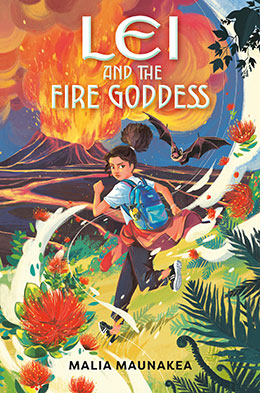
Lei and the Fire Goddess by Malia Maunakea is a rare gem in kid lit: an epic coming-of-age story written by a Native Hawaiian author featuring Native Hawaiian characters.

The story introduces us to twelve year old Lei, with all the joy and snarkiness and insecurity that are part of growing up. It didn’t take long for me to get into the story. From the very moment she steps off that airplane at Hilo airport, Lei is a fully developed, fully likeable character.

So are the secondary characters, especially Tūtū, ʻIlikea, Moʻo, Kamapuaʻa, and the formidable Pele. I won’t spoil it for you by revealing too much. Just know that the characters of Hawaiian legends come alive in the author’s vivid storytelling and are integral to Lei’s growing awareness and maturity.

There is so much I love about this book.

I loved Lei’s character arc, watching her grow, facing her fears, devising solutions, and facing the consequences. The exciting major scenes — between Lei and Kamapuaʻa, between Pele and Poliʻahu, the holua sled race — grab the reader and donʻt let go.

But even the quiet moments, such as Lei vowing not to share the waterfall on social media and later realizing why telescopes donʻt belong on Maunakea, speak volumes,  especially to ʻōiwi readers.

I love how the language is geared to today’s audience without being dismissive of the memories and upbringing of the older readers the story might appeal to. The ʻōlelo Hawaiʻi is not a trope but a real storytelling device. For example, Tūtūʻs “close the mouth” line in an early scene is such a Hawaiian way of teaching and learning.

I loved what felt like inside jokes but are really evidence of the author’s authentic voice: KTA, the tin roof, Iz’s song, li hing mui snacks, pidgin. I love that the first hula that comes to Lei’s mind is the one we all learn as kids, Kahuli Aku. And I laughed out loud at the chapter titled “Ma-ke Die Dead.”

Now the elephant in the room. At first I was super nervous about Pele being a main character. Our kūpuna teach us to respect and revere her. There will always be traditionalists who feel the Pele story should never be retold in a modern voice.

Yet, for me, more than anything, I love how creative the story is. It’s respectful and authentic and adds to the Pele and Kamapuaʻa canon for today’s kids. Pele truly sounds like the goddess I grew up hearing about. That she becomes Lei’s frenemy is edgy and feels right. 

Kids’ books by lived experience/own voices authors are so important. I am Native Hawaiian and grew up in the 1960s. There were no books – not one! – where the characters looked like me, did the things I did as a kid, ate the foods I ate, or used the pidgin I spoke. All kids deserve to see themselves in children’s lit.

This is why books like Lei and the Fire Goddess are so important. It’s a beautifully written, rollicking exciting-scary-funny story that kids everywhere will love. For all these reasons, LEI is a must-read.

Lei and the Fire Goddess  
By Malia Maunakea   
Penguin Random House
2023
ISBN 9780593522035
Suggested for ages 8 – 12

Mahalo to Sierra Pregosin at Penguin Random House for access to the galley! 

Learn about author Malia Maunakea in our talk-story interview. To look up the definitions of the Hawaiian terms used in this post, please visit Wehewehe.org