 Kamalani Hurley
Interview with Native Hawaiian Writer Adam Keawe Manalo-Camp
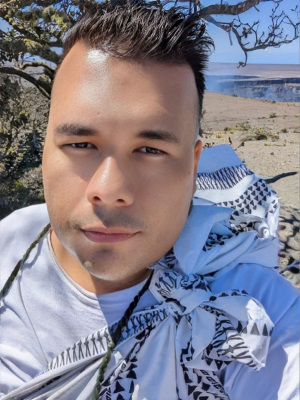
Our ongoing series on Native Hawaiian and local Hawaiʻi writers continues this week with Adam Keawe Manalo-Camp, the talented Native Hawaiian writer and blogger. If you’re a regular reader of Ka Wai Ola O OHA, then you’ve no doubt read Adam’s wonderfully interesting, well-researched articles about the history and culture of our people.
I’m a huge fan of your writing, Adam. But for those who haven’t met you, could you please tell us a little about yourself?
The homelands of my ancestors are Hawai’i and the Philippines. My grandmother grew up in Honokaʻa while my mother and I grew up in Kewalo within Papakōlea Hawaiian Homestead. My ʻiewe and piko are literally buried at Papakōlea. I also spent a chunk of my life in the Philippines. As far as my research background is mostly in history and anthropology.
Where did you grow up? What high school did you grad from?
I grew up within Papakōlea and am a product of Hawaiʻi’s public school system. I graduated from Roosevelt High School.
Who is your biggest supporter?
My husband. He’s been with me from the very beginning when I was getting my master’s in counseling psychology and veered off course to be a freelance writer. The latter and marrying him were the best decisions I made (besides having kids)!
That’s awesome. Why did you become a writer? What inspired you to write for children?
In general, my ancestors. But my mother always encouraged me to write.
Why did you become a writer? What inspires you to write y0our posts and articles?
I have always liked to write. The first time that a piece of mine was published was in the ʻŌʻiwi Literary Journal, and I was graduating high school. The late Māhealani Dudoit had discovered me through a long email chain where I was talking about the importance of King Kalākaua’s world tour of 1881. I was very self-conscious because ofbeing māhū, neurodiverse, and having English as my second language—Hawaiian was my first. Māhealani said she loved how unique my voice was and encouraged me to keep writing. It took me a long time to realize that what I told in school were my weaknesses are actually my strengths.
Then some eight years ago, I began writing posts on social media and recently my other pieces and some of my research have appeared in Civil Beat, Ka Wai Ola o OHA, NatGeo, etc.
What do you enjoy most about writing? What are some of your greatest challenges in writing your articles and posts?
When I write posts, I think of them as love letters to my ancestors and to my culture. I do not have a social media calendar or plan things out. I write because something inspires me to and I found a particular topic interesting. I also write in honor of my grandmother and mother who used to constantly fill my thoughts with stories of their times and the times of the ancestors. I know many Kānaka Maoli who read my posts may not have their kūpuna around or have been scattered throughout Turtle Island, and so I would hope some of my posts may be a small light to remind them of where they came from.
Social media can bring so much positive attention to indigenous peoples but social media can also be challenging. Some folx are on social media platforms simply for clout or to attack people behind a wall of anonymity. I try not to focus on those people but to focus on the folx out there who are searching for manaʻo and want to engage in aloha.
I always learn something new from your posts. What are your hopes and dreams for the year and beyond in terms of your writing career and what you would like to see published in the future?
I have a couple of articles coming out this year including pieces on Kaomi. The pandemic sort of made me rethink my career and what I want to write about. I would want to write more local Filipino and queer histories as well as more on Hawaiian struggles from a historical point of view. I would like to also write more fictional short stories.
I always ask the following of the writers I interview: There are not a lot of stories for local kids by local writers. Why do you think that is? What do you think we can do to change that?
I think in general there aren’t a lot of works for children by BIPOC writers in general. A lot I believe is the lack of access to publishers as well as economic factors. There are a lot of creative Kānaka Maoli out there that I know of but due to the cost of living and other expenses, some see being creative as a side hassle as they feel that being creative cannot sustain them financially. I myself would not know how to get started in that field.
Do you have a website? Are you on social media? Do social media play a role for you as an author? Do your readers contact you? What do they say?
My linktree is linktr.ee/adamkeawe That features links to some of my work and my blog. I got on Facebook about eight years ago, and on there I am admin for the Hawaiian History and Culture group, which has 34,000+ members. Instagram I got on right before the pandemic and that is where I am more active. I also have Twitter but am not too active on there. All of my handles for my social media accounts are: adamkeawe.
In general readers are supportive and engage in discussions.
What advice do you have for aspiring writers?
If your naʻau keeps pushing you to tell a story, youʻre a writer. Never be discouraged nor base your self-worth and your writing on how many likes of followers you have. In the end, you will connect with who you need to connect with.
Can you share a bit of your current work?
I have two pieces coming out soon. One is about Kaomi and another is about my motherʻs best friend who was a transwoman in the 1970s.
What beliefs are your stories challenging?
Patriarchy, settler colonialism, homophobia, racism, and anti-Semitism.
Where do you get your inspirations?
I draw a lot of my inspiration from my ancestors and talking to other Kānaka Maoli. But I also read other writers from various genres including Joy Harjo, Ninotsche Rosca, Noam Chomsky, Langston Hughes, Audre Lorde, Stephen King, and so many others. Science fiction such as The Expanse, Star Trek: Deep Space Nine, and Babylon 5 inspires me as well.
Your articles and posts demonstrate a lot of research. Whatʻs your research process like? How long is your research for a typical article?
Normally I have at least three sources per article. In social media posts, minimum two. Before I begin a major writing assignment, I chant “E hōmai…” and ask to be guided. I do the same privately before entering a library or archives. I am mindful that research is ceremony and methodology is ritual, and I try to bring that into whatever I am working on.
Have you ever considered writing a longer work, like a book or screenplay?
Yes. I would rather collaborate though because of the time that it takes.
Can you share a bit about what you are working on next?
I am collaborating with Kumu Lua Michelle Manu on a book about women warriors.
Women warriors? I look forward to that. Adam, mahalo nui for sharing your manaʻo! To learn more about Adam Keawe, visit his LinkTree.
Moke Action, by Award-Winning Native Hawaiian Filmmaker ʻĀina Paikai
 Hawaiʻi Creole English — called “pidgin” by its native speakers — dates back 100 years to the sugar plantation days. Immigrant workers, first from China, then Japan and other countries, needed a way to communicate with their fellow workers and with the people who lived among them, the Native Hawaiians. Pidgin is still spoken in Hawaiʻi, and being fluent is a source of great pride by its speakers. Pidgin is what makes us local.
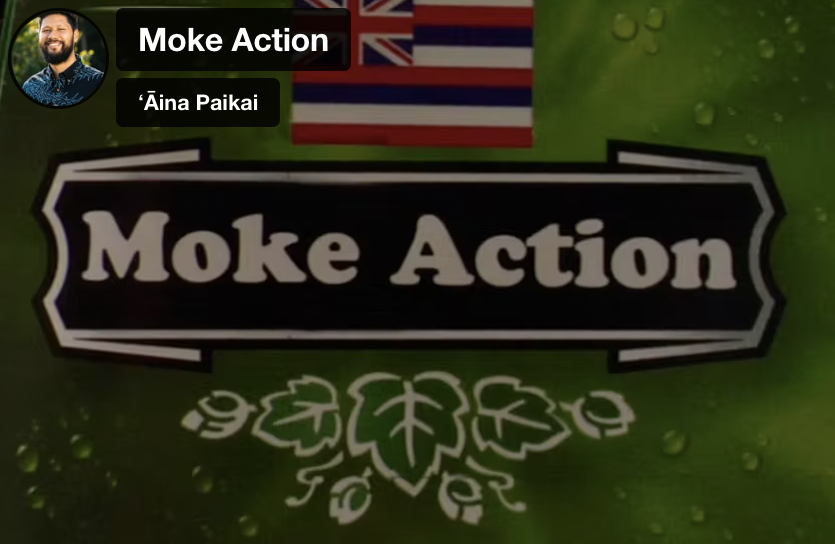
One of the most popular videos we published at Pūpū was this little gem, Moke Action, an early film directed by the talented Native Hawaiian filmmaker ʻĀina Paikai. Not surprisingly, ʻĀina would go on to make many award-winning short films, including the wonderful Hawaiian Soul in 2020. Moke Action, starring Brutus LaBenz, Brahma Furtado, and Liona Arruda, is the tale of two young men who nearly get into an unfortunate scuffle. Happily, they are prevented from committing violence, thanks to their respect for their elder. Or, in pidgin:
Two guys like scrap til aunty wen scold dem.
Exactly.
Interview with Author Dani Hickman
Welcome to our latest interview with Native Hawaiian and local Hawaiʻi writers! Author Dani Hickman is the author of four delightful children’s books published by Island Heritage.
Hi, Dani. For those who haven’t met you, could you please tell us a little about yourself?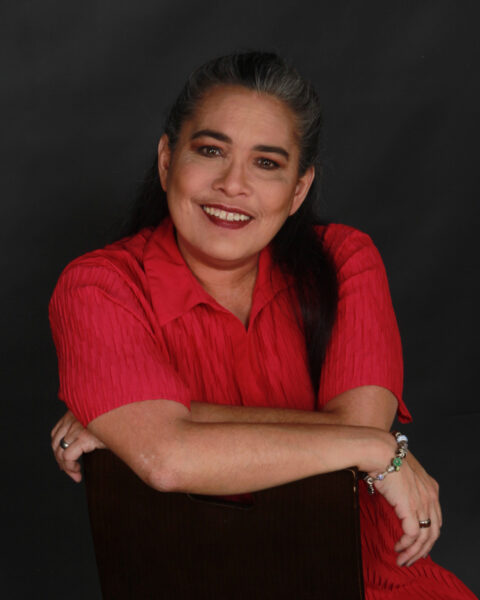
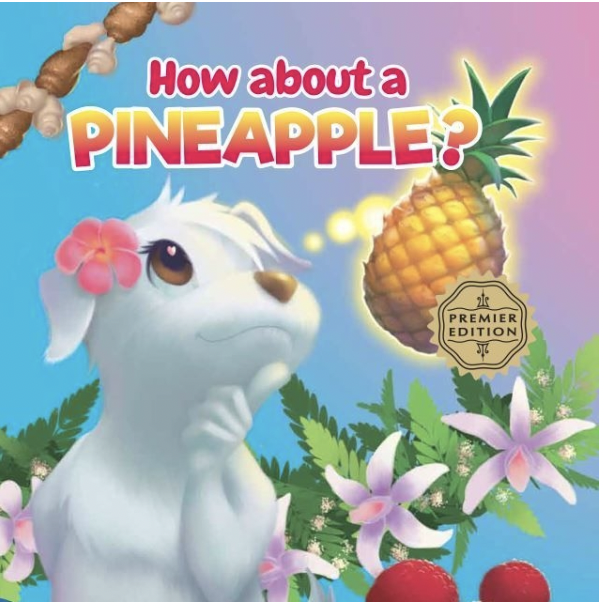
I’m a married local girl with four adult children. My youngest, who co-authored two of my books (How About a Pineapple? and Tako Lends a Helping Hand) just went off to college. My home in Waipio is still full with four dogs, one cat and one very fat beta fish. My day job is in Human Resources at a local adult in-home care service.
Where did you grow up? What high school did you grad from?
I’m a townie who graduated from McKinley High School. Go Tigers!
Indeed! Who is your biggest supporter?
My husband, Jeff, is my partner in all things. From raising the kids, to editing my writing, to being my arm candy at author events, Jeff has always been my rock. He is a Kamehameha grad and retired National Guard Veteran. His feedback and contributions in my stories definitely helps me add more “flavor” to anything I do.
Why did you become a writer? What inspired you to write for children?
I’ve always written short stories and poems since I was little. Publishing always seemed like something that was too difficult to achieve and I had no idea where to even begin. I had a co-worker, Tammy Paikai, who published a few children’s books and inspired me to give it a try. She was incredibly helpful and encouraging with all the behind the scenes stuff, like setting up for a book signing and being resilient during the editing process. I also LOVE her books. “Too Many Mangos” is my favorite Tammy Paikai book, so relatable in Hawaii and a great lesson of giving.
What do you enjoy most about writing for kids? What are some of your greatest challenges in writing for children?
I love the book signings and reading at the schools! Meeting children and hearing them say how much they love the story is such a heartwarming experience. My biggest problem when writing for children is my love for big words. Keeping stories at 2nd grade reading level and replacing “verbose” with “talkative” or “mean” in place of “malicious” is a challenge. My kids always loved “big” words but my editor has a different viewpoint.
What are your hopes and dreams for the year and beyond in terms of your writing career and what you would like to see published in the future?
I’d like to publish a chapter book for teens with a Hawaiʻi storyline. Maybe even a  Hawaiʻi graphic novel. I’d also love to do a sequel for my first book, Pono, the Garden Guardian. He’s my favorite little guy with a big heart. I have a rough idea of what I’d like his next chapter to be. Publishing another adventure for him would be amazing.
There are not a lot of stories for or by Native Hawaiians and Pacific Islanders. Why do you think that is? What do you think we can do the change that?
I agree that there are not enough Hawaiian/Pacific Islander children’s book authors. In my opinion, I think part of that stems from the Hawaiian culture itself. Hawaiian is a spoken language, traditionally passing stories through chants, song and dance. The lack of a written Hawaiian language did not become issue until the arrival of the missionaries. Today, there seems to be a limited group of traditional kumu who are perpetuating the culture as they always have, through oral teachings. I think more in the community are trying to reach out to keiki, but unfortunately, the pool of knowledgeable experts with a passion for writing and a focus on children’s stories is small. It may be helpful to have more outreach by cultural groups to encourage keiki to put their demands out there for books and also writing their own stories.
Do you have a website? Are you on social media? Do social media play a role for you as an author? Do your readers contact you? What do they say?
My website is sorely out of date. Iʻm also on Facebook. I been have slacking off considerably in promoting my books in the last couple of years. My focus was on my family and getting my daughter set up for college. Now that she is in college, I hope to get back to it. I have gotten email sent from my website, direct messages and comments on facebook and my direct email. Most of the feedback was through social media. A majority of the comments were around how much they liked the characters. A few made welcome critiques of different directions the  story could have gone. My favorite bit of feedback was that I didn’t name the puppy in How About a Pineapple? I purposefully left out a name because I noticed many children coming to book signings mentioned that their dog was the dog in the book. I felt naming the dog excluded all those keiki with white dogs that wanted to imagine their puppy on an adventure. The dog is named Kea in the book description but not in the story, and I still appreciate the comment.
What advice do you have for aspiring writers?
READ READ READ! Learn how others weave their stories and develop their characters. All those different styles helps you find your own. Be open to feedback from others, it can only make you better. Write about what inspires you. Don’t be discouraged — keep trying.
Can you share a bit of your current work?
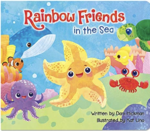 The last book I published was a baby book, Rainbow Friends in the Sea. I’ve always loved rainbows and wanted to write a color book for little ones. It’s a board book with a simple rhyming theme showing the basic colors of the rainbow in sea life. My favorite part of the book is a mirror in the end, because “You’re my newest Rainbow Friend.”
Which of your books did you have the most fun writing? Which were the most challenging?
Writing How About a Pineapple? with my daughter was the best experience. At 12 years old she was bursting with ideas and edits. It was a blessing working with her.
My first book, Pono the Garden Guardian, was the hardest to write. I invested a great deal of my heart in that book, and it was too long. The text needed to be cut in half. Cutting something you love down to its core was very difficult for me but also a valuable lesson. Great stories can be a relationship between the author and the reader. Using fewer words allows the reader to fill their mind with the pictures they create. The writing is just there to point and to guide.
What beliefs are your books challenging?
I think there are many stories about heroes. I believe everyone can be a hero. You just have to decide how. My characters aren’t “super,” they’re YOU in different situations. They’re YOU choosing to be a good person in a small, but significant way.
What’s your experience with publishing your books?
I’ve had good experiences with my publisher. Island Heritage is well known for quality and has a history of amazing works. I’m honored that they allowed me to share my stories and support me as an author.
Where do you get ideas for your books?
I write stories I want my children to learn from. I take a lesson like self-less giving, doing what’s right and working well with others, and I have the characters show you why that lesson matters. Inspiration is everywhere and in common everyday things. Children’s stories should shine a light on a different way to look at something, from different perspective. It’s a great way to learn no matter what your age.
Which characters do you relate with easily? Why?
The character closest to me is Tako Lends a Helping Hand. Tako wants to 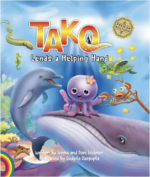 help everyone but takes on more than she can do and ends up forgetting everything she’s already promised. Managing tasks and time while working with others to get things done is something I think many people can relate to. Tako is an octopus, so it’s a little wishful thinking to hope for a few extra hands on busy days.
Can you share a bit about your next book?
I always have 10–12 books in different stages at all times. It’s common for me to put something down for months and come back to it with fresh eyes. The book I have that’s a bit farther along than most is a story about not wanting to go to bed. It’s got more of a national theme, and it rhymes, which is always a bit more challenging to get the rhythm right. Many parents can connect to a story of a child wanting to stay up a little later than they should.
Mahalo, Dani, for sharing your manaʻo with us! To contact Dani Hickman and learn more about her books, please visit her website at thedanihickman.com.
Fishing for Grandma by David Manu Bird
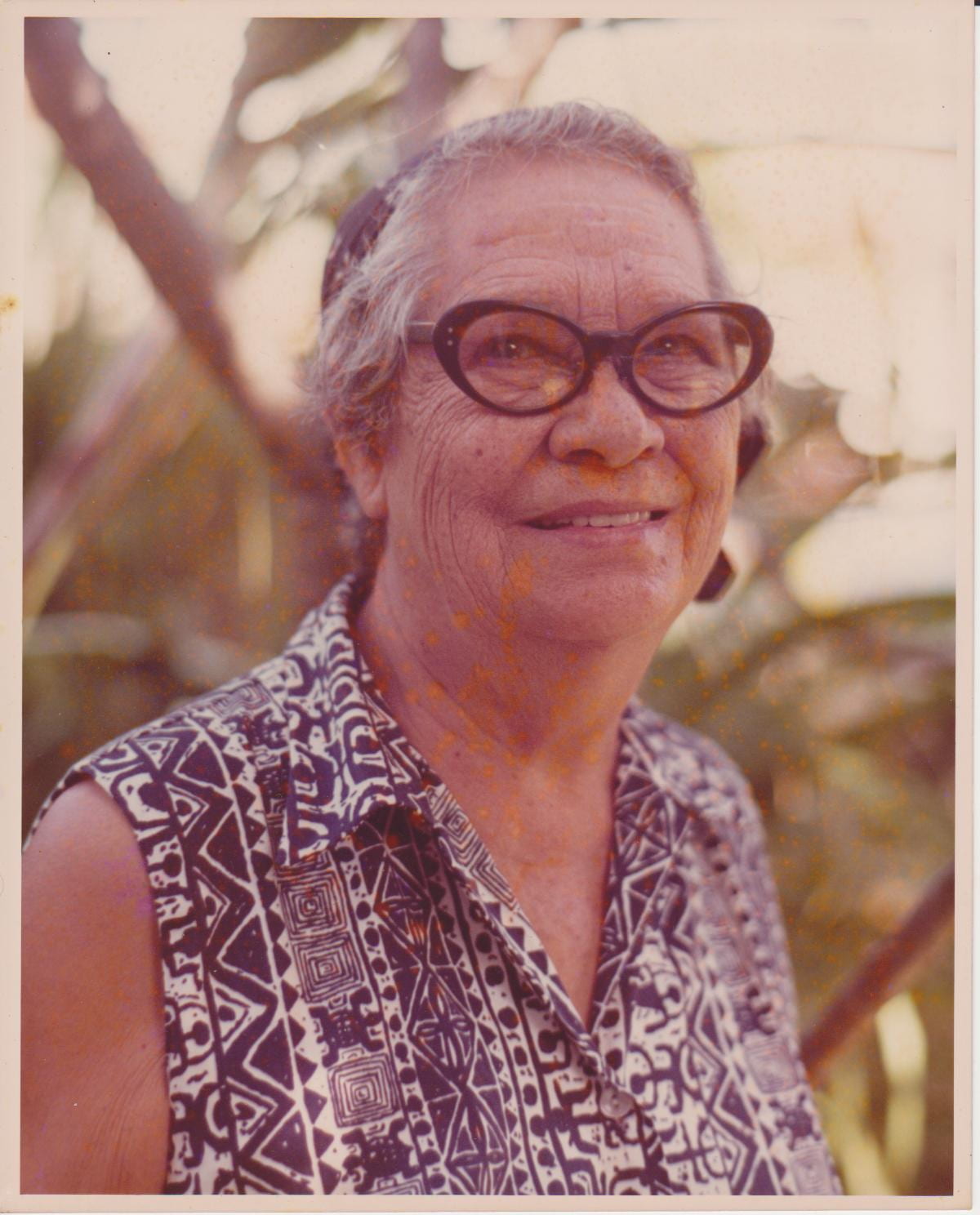
Some of my favorite popular posts when I published Pūpū A ‘O ‘Ewa Native Hawaiian Writing and Arts at Leeward Community College were personal essays by students and faculty.
Fishing for Grandma, by my colleague and longtime friend, Dave Ka’apuwai “Manu” Bird, was first published in 2014. About this essay, one of our readers wrote, “I especially loved reading Manu’s narrative…brought back some memories with my own ʻohana!” I know that in sharing his story, Manu was glad that someone else connected to their own kupuna.
Manu joined his ancestors earlier this year after a brief illness. He leaves behind his loving family — wife Mary, son Keoni, daughters Mālia and Tinan, and moʻopuna — as well as his many students, colleagues, and friends. E Manu-Tok, nui ke aloha ia ʻoe.
Watch our video interview with Manu Bird.
Fishing for Grandma by Dave Manu Bird
“Goddam dis buggah!” I exclaimed as the kūkū of the pua hilahila dug into my hand. Like the entire old cemetery beside the Waikāne Congregational Church, the grave I was cleaning was infested with the thorny plants.
“Please remember where you are,” Mary scolded, taking umbrage with my profane language.
“How can forget?” I shot back.
“Well, if you cannot respect God, you could at least respect the dead.”
“So?” I muttered to myself. “Stay make da kine make guys anyway.” With that, I knew that I was getting stink eye from my wife.
My sarcasm was the result of stress, not how I felt. As I surveyed the graves around me, I still couldn’t believe that Grandma was gone. Her death still didn’t seem real. What was real, however, was the pain of the kūkū poking my knees through my jeans. Once again I bent over, carefully pushed my fingers under the branches of another pua hilahila plant, pinched its stem tightly, and yanked the whole thing out of the ground by its long tap root. I threw the plant on a nearby ‘ōpala pile and reached for another.
It was hot, and I was sweating, but as I worked I could not help but remember Grandma’s voice even though it had been physically stilled forever. I couldn’t help but think how much Mary and Grandma often sounded alike. They both usually spoke that crisp English locals always speak when they don’t want to sound local. They e‑nun-ci-ate care-ful-ly.
“When are we going?” 13 year-old Keoni whined, pulling me out of my reminiscing. He was bored and wanted to get on with our picnic and fishing expedition to Kahana Bay, our destination after the graveyard.
“‘E Keoni, kulikuli, ‘eh,” I responded.
I didn’t need a punk kid’s hassles adding to my misery. I was wilting because of the heat, the kūkū, and the complaints. I was also getting tired of the general uneasiness I felt because only Mary, Keoni, Mālia, Tinan, and I were there at the graveyard. It did not seem right to me that only our nuclear family was taking part in Grandma’s post-funeral funeral without representatives from the extended family, even though no-one else was able to join us.
Grandma’s formal funeral had been held the month before. Family members had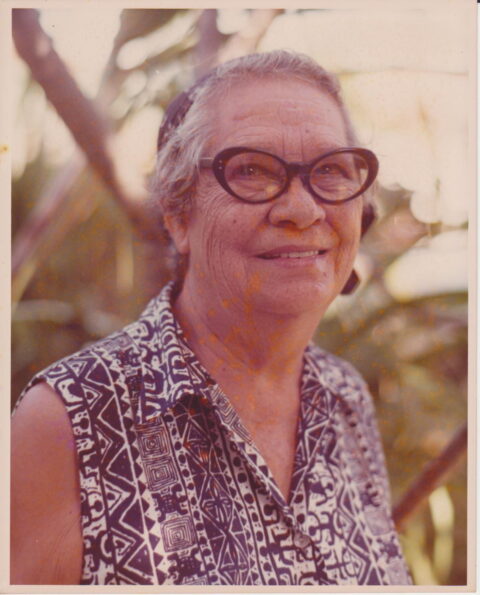 gathered together from Kaʻimukī, Kailua, Kāne’ohe, Nānākuli, and the Mainland. That day, we scattered most of Grandma’s ashes along with thousands of flowers and prayers off of Kahala Beach Park. We gave Grandma back to her beloved moana and ‘āina at that place because it had been one of her favorite fishing spots, at least in the days when Kahala consisted of groves of kiawe trees, a dairy farm, and a hodgepodge of week-end beach cottages. Before the main funeral started, Mary and I put a kapu on a little bit of Grandma. We wanted to bring a part of her to the windward side, another of her favorite fishing areas. That day in Waikāne, we had two film canisters filled with Grandma’s ashes, all that was left of her in this world.
Finally we could read the inscription on the grave headstone that I was cleaning:
Martha Koolau
Died Dec 10, 1931
Age 50 Years
Martha Ko’olau was Grandma’s mother; Grandma had lived to be 92.
My cleaning work finished, I stood and stretched. One of the kids retrieved a discarded pua hilahila and used it to brush the dirt off of the gravestone.
I suddenly felt strangely light-headed and absent minded. “Pau dis,” I said. “Mu fek ea nunuw nga. . . I mean time for da lei and stuffs.”
Without thinking, I had momentarily switched into our hānai daughter’s native language. Then as I looked down at the grave, it struck me how kapakahi we all were – and are. We are like cultural schizophrenics who switch personae seemingly without reason. We were exactly like what Grandma had been. For years I tried to understand Grandma, the last family member born in the 19th Century and the only one we knew who had seen, talked to, and had even sung for Queen Lili’uokalani. But Grandma had been like a mo’o that changes its colors. She was hard to see because she blended in with her immediate surroundings. She never told us very much about herself. She was excessively reticent about her childhood and early adult life. She never talked about her mother. So what about us?
My sudden question was a revelation. If Grandma was an enigma, then so are we. Who was Grandma? By extension, who are we?
Mary and the girls began laying lei, flowers, and lā’ī around the headstone. As they did, I looked out at the vehicles roaring past on Kamehameha Highway a few yards from us. The sight of the cars pulled my thoughts back to long ago when we were traveling down the same road …
… Has it really been 20 years since we passed here in Mom Z’s old Chevy II station wagon? We were headed for Uncle AP and Auntie Sam’s beach house in Ka’a’awa for a week’s worth of fishing and swimming, a mid-summer break and the ‘oama season we always looked forward to. Grandma’s voice and Grandma’s words that day are still as clear to me now as a Kāne’ohe Bay reef when there’s no run-off pollution to silt the water. She was scolding me.
Auntie is stupid. You are stupid for letting her make you take these bananas. I would never have gotten in the car if I had seen them. You never take bananas and manure to the beach. When you “ go to the mountains,” you must do things properly.
I no like take kūkae no place, especially holoholo.
Boy, no tok lai’ dat! Speak pro-per Eng-lish .…
That was vintage Grandma. Rarely, though, did she raise her voice like this to me or her other mo’opuna. She didn’t have to. She never touched us, but she could whack us aside the head with a withering look if we did something that displeased her or violated her sense of propriety. To this day, she is alive. I know so. I can no longer give her a hug or kiss her on her velvety cheek, but there is little I do unless beforehand I ask myself If I do this, would Grandma’s maka smile at me or give me stink eye?
But who was this woman? And by extension, who are we?
Occasionally Grandma would pass on to us snippets of Hawaiian lore and protocol, especially about fishing – her life-long passion. But what about the rest of the mana’o she had gathered during the course of her long life? What about growing up in rural Puna, attending Saint Andrew’s Priory as a boarding student, and singing on the Hawaii Calls radio program in the 1930s and 1940s? What adventures did she have? Whom did she know? Why could she understand spoken Hawaiian but not put two words of the language together to speak it?
As I stood by the grave watching Mary and the kids arrange the lei, I could only speculate. She was not atypical for her generation or the next in her reticence. Could the effects of 1893 have silenced them all? Hawai’i was once one of the most literate nations on earth with an active Hawaiian language publishing industry and citizens who were avid readers and writers. In 1896, the haole leaders of the Republic of Hawai’i passed a law banning Hawaiian as a language of instruction in schools, a law that was not repealed until 1983. Teachers physically beat children if they spoke Hawaiian, and teachers visited their students’ homes and scolded their parents for speaking Hawaiian in front of their children. The Hawaiian language almost went the way of Latin. Were these the reasons for generations of kūpuna silence?
Who was Grandma, a person who was born in Old Hawai’i but who died in Modern America? Who was this person who worked as a faithful cashier at the original Willows restaurant in Mo’ili’ili for decades until she was in her 70s? She had a strong American work ethic, but still she would occasionally drink Scotch before work or call in sick to go fishing. What caused her to be kolohe?
And who are we? As we stood by the gravesite, I could not help but wonder what perspectives we no longer understood and probably never would because of Grandma’s silence. I felt like we were already at Kahana Bay, trying to catch fish in depleted and degraded waters.
Mary brought me back into reality, for the ho’okupu was in place. We stood around the grave holding hands over a prayer, and then we took turns sprinkling Grandma’s remaining ashes over her mother’s grave. We knew that eventually the life-giving ua would soak her remains into the sacred ‘āina, mingling her with her mother’s iwi and binding us once again to the long line of kūpuna and ‘aumakua that stretches back into antiquity.
After we finished scattering Grandma’s ashes, we once again joined hands for pule. “E ko mākou makua i loko o ka lani,” Mary began to intone. But just then a long line of tourist buses heading for the Polynesian Cultural Center roared past 15 feet from us, drowning out Mary’s words. The buses’ diesel engines blasted us with storms of blue-black exhaust and silenced our prayer to Grandma and to God.
E Heluhelu Kākou: No ke Anilā
The Hawaiian language — ʻŌlelo Hawaiʻi — is a beautiful, rich language. Thanks to the internet, ʻōlelo can now be heard across the globe. 
Read-aloud versions of childrenʻs books in English are readily available online. And now thanks to Kamehameha Publishing, books in ōlelo are, too.
I am pleased to feature No ke Ahilā — Our Hawaiʻi Weather, a delightful bilingual boardbook for keiki, written by Kaulana Domeg and Mahealani Kobashigawa and read by fluent ʻōlelo speaker, and wonderful presenter, Makiʻilei Ishihara.
Interview with Writer Brandi-Ann Uyemura
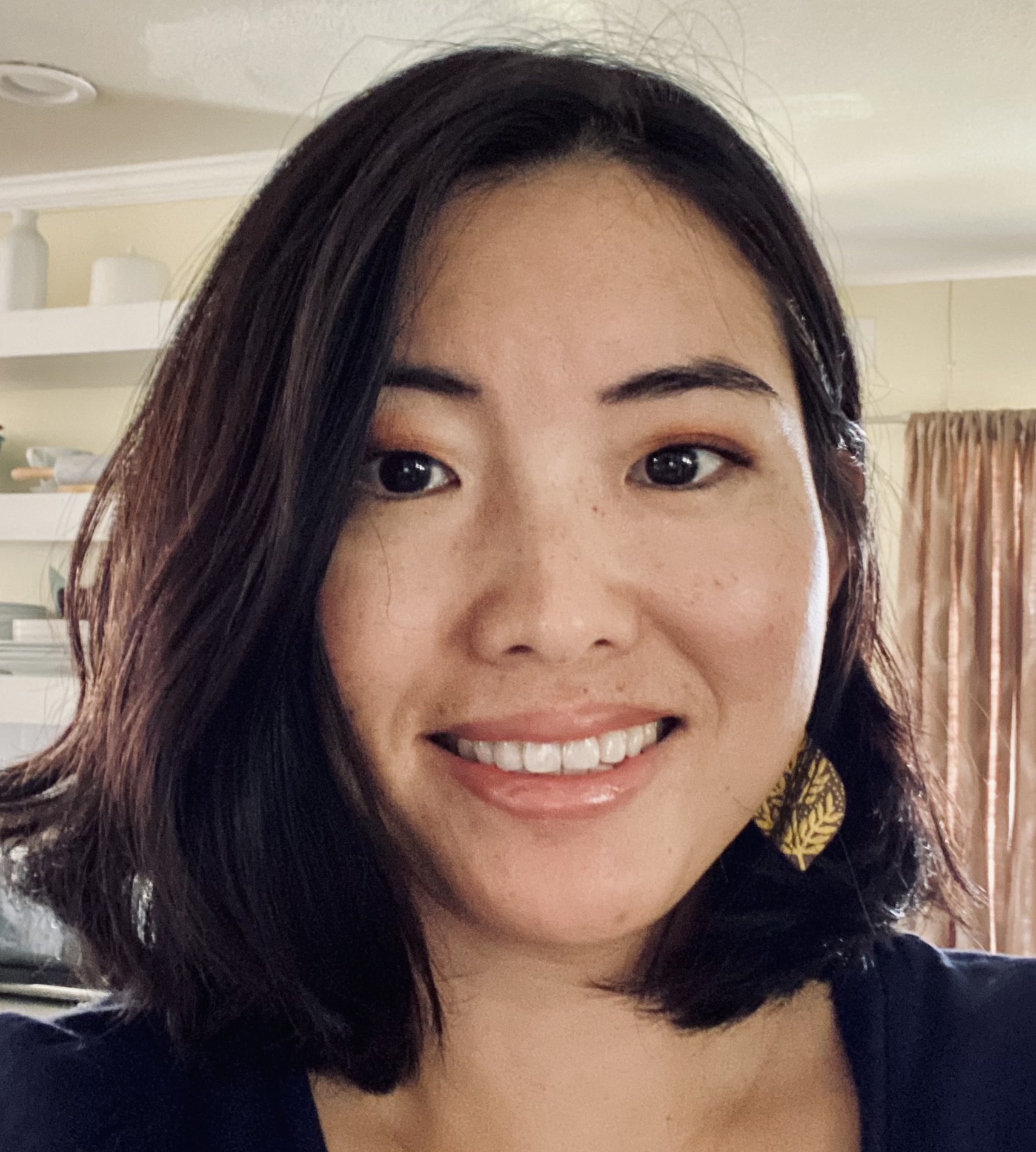
Our ongoing series on Native Hawaiian and local Hawaiʻi writers continues this  week with my friend, author Brandi-Ann Uyemura. Writing coach, blogger, coach and author, Brandi does it all. Her articles and essays inspire hope, courage and compassion. An Asian American who grew up in Hawaiʻi, Brandi brings a much needed authentic voice, not just for Asian kids in Hawaiʻi but for all kids, everywhere.
Hi, Brandi. Thank you for allowing me to feature you. For those who haven’t met you, could you please tell us a little about yourself?
Hi! I’m Brandi, a writer and mom of two young boys. I grew up in Honolulu, Hawaii and went to Aiea High School.
Go Na Aliʻi! Who is your biggest supporter?
My husband. He’s been with me from the very beginning when I was getting my master’s in counseling psychology and veered off course to be a freelance writer. The latter and marrying him were the best decisions I made (besides having kids)!
Why did you become a writer? What inspired you to write for children?
I think I’ve always been a writer. I just didn’t know you could do it for a living. It’s funny I coach creative women and I often say that the thing you say you would never do, is often the thing you want to do most. When I got my BA in English from the University of Oregon, I could have gone the children’s writer route, but I never thought I would write for kids. I even interned at Skipping Stones, a multicultural children’s magazine.
One of my earliest memories in school was having to create a picture book. I think it was about rats or something lol. It was a pivotal memory because I remember thinking: wow you mean I can write a book?
What do you enjoy most about writing for kids? What are some of your greatest challenges in writing for children?
I have fond memories of reading books in my youth. It was that one moment when I felt that visceral experience of being in the story. I think every reader remembers reading Charlie and the Chocolate Factory and wanting to eat chocolate or getting chicken skin from Toni Morrison’s Beloved. I’ve almost never been able to recapture that feeling as an adult. When I write for kids, I get that magical experience of feeling like anything is possible.
Oh, yes, I know what you mean. What are your hopes and dreams for the year and beyond in terms of your writing career and what you would like to see published in the future?
I hope to get more of my picture books on submission and my middle grade mystery in submission shape. I have other fiction novels that I’ve started, another middle grade, and two women’s fiction novels. Once my kids are in school again, I hope to really get deep into those.
I think I will always be a writer. Fiction is new to me and yet, it feels like coming home There’s something fresh and delicious about writing fiction that I haven’t experience writing nonfiction.
There are not a lot of stories for local kids by local writers. Why do you think that is? What do you think we can do to change that?
I don’t know exactly why that is. And you and I have had conversations about that. It’s so important to have these unique cultural experiences on the bookshelves. I think we need to support other local and indigenous writers with stories to tell. I think what you’re doing: writing about your own culture, working to get them published and featuring local writers and authors on your website are pivotal ways to change the landscape.
I agree! Do you have a website? Are you on social media? Do social media play a role for you as an author? Do your readers contact you? What do they say?
I have two websites: The Inspiring Bee and Brandi-AnnUyemura.com. The Inspiring Bee was created decades ago and is all about inspiring people to follow their purpose. The other website is a place for writers. Both have helped me get jobs and connect with writers in the decade or so that I’ve had them so I am grateful for both.
I’m on Twitter, Facebook and Instagram all with @TheInspiringBee. I met my first freelance writer friends over a decade ago through my blog and Twitter. I’ve also met IRL mom friends and coaching clients solely through Instagram. Right now, I’m prepublished, so I’m using social media as more of a way to connect and find inspiration from other creative’s platforms.
What advice do you have for aspiring writers?
If I were to speak to an aspiring writer, I would tell them their words matter. There is always room in the collective for their voice and that anything they don’t know, they can learn. The main thing is to keep going. The only way to become the writer you dream of, is to write. Write despite fear. Write despite insecurity. Write despite what anyone else says. And don’t show your work to anyone in the early process. Give yourself the freedom to express and put everything down on paper. You can always go back to revise.
Can you share a bit of your current work?
I wrote a picture book about the local Japanese Bon Dance here in Hawaii. Originally, it was written in third person and was basically a documentary on a real scene at a Bon Dance lol. I had no idea what I was doing. It has had multiple iterations since then and is now written in first person.
What beliefs are your stories challenging?
I think culture, courage and being and accepting yourself. It’s a story about connecting with your ancestors.
What is your inspiration for your stories?
My own life as a mom raising two boys for sure. And my family’s life growing up in a sugar plantation in Kauai. It’s a mix of everything I’ve read, researched and lived.
Which characters do you relate with easily? Why?
I can relate to my main character being afraid to dance in front of everyone. I really grappled with this story for years until I had an amazing mentor, Andrea Wang from PBChat. She helped me to get to the heart of my story.
That’s cool. Are you working on a new writing project? Can you share a bit about your next book?
I am revising a middle grade mystery. It’s about six years in the making. What motivated me was receiving a SCBWI mentorship and Highlights scholarship. These came right when I was about to throw in the towel. It’s a story that blends my own past experiences working at a chocolate store, as a private investigator and middle school therapist. It’s a chocolate mystery about an Asian American girl growing up in an almost all white community where she befriends her former nemesis and bully, and learns that we’re all a mix of bitter and sweet. None of us immune to the evils of the world.
That sounds intriguing Brandi. Mahalo for sharing your manaʻo and best wishes always! To contact Brandi-Ann Uyemura, visit her on social media or The Inspiring Bee and Brandi-AnnUyemura.com.
A Nation of Our Own, Spoken Poetry by Chris Oliveira
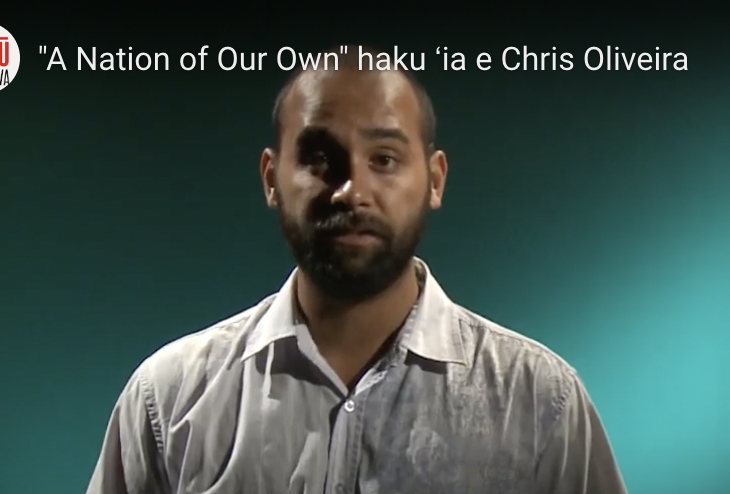
Native Hawaiians have a rich oral tradition that spans over a thousand years. Our stories are told in many forms: songs, chants, hula, legends, ʻōlelo noʻeau, and word play. Modern Hawaiians continue our ancient tradition by weaving their stories into beautiful spoken poetry.
Chris Oliveira is a fluent Hawaiian language speaker and a dedicated Hawaiian activist. Hailing from the Waiʻanae Coast, he is the Vice President and Executive Director of Koa ʻIke, a community non-profit organization that focuses on place-based, service learning educational initiatives and student exchanges.
First published in 2014 by Pūpū A ʻO ʻEwa, A Nation of Our Own is a powerful, provocative lamentation on the loss of our sovereignty dating to the 1893 U.S.-backed coup dʻetat that overthrew our indigenous government. Mahalo nui, Chris.
Watch our interview with Chris.
Interview with Native Hawaiian Author Tammy Paikai
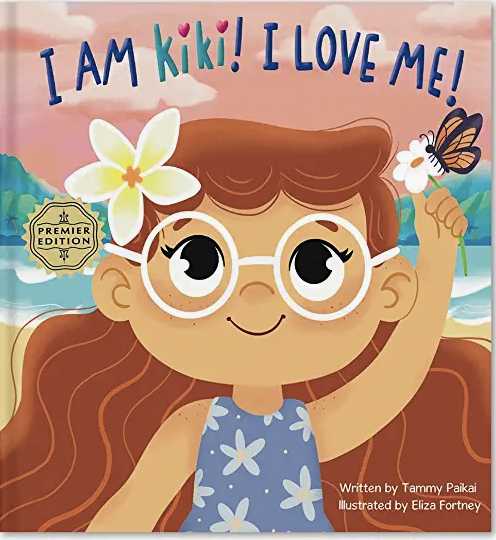
Today I am delighted to feature my friend, the talented Native Hawaiian author Tammy Paikai. Her five picture books cover subjects that teach children important life lessons but do so in a fun and approachable way that kids — and their parents — love.
Aloha, Tammy. It’s so good to talk with you! For those who haven’t met you, could you please tell us a little about yourself?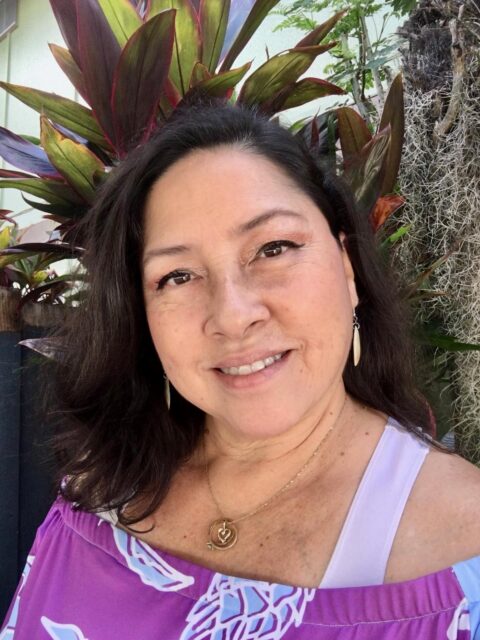
I like to describe myself as a kind and good person. I was inspired by my father who was my role model growing up. He was a gentle soul, yet had a witty sense of humor that always made me laugh.
Being a young mom of three wonderful children, my first career was to help support my growing family. I worked for 20 years at The Plaza Hotel by the Honolulu International Airport as the Senior Reservations Clerk. In the hospitality industry I could help others and that gave me the most satisfaction.
My second career was for me because I had always wanted to do something creative in my life. I worked for Island Heritage as a Customer Service Representative and Front Office Administrator for 17 years, and it was such a joy to be around so many creative people. I feel so blessed that Island Heritage gave me the opportunity to write books for children. It has really been a dream come true.
Where did you grow up? What high school did you grad from?
Although I was born in Honolulu, Hawaiʻi, my elementary years were mostly spent in Reseda, California. I returned back to Hawaiʻi when I was 10 years old and attended several schools on the West side of the island. I eventually graduated from Aiea High School. Living in Hawaii was where I learned about all the different ethnicities and cultures of the islands.
Who is your biggest supporter?
My biggest supporters are my family, especially my husband of 40+ years. He always believed in me and my talent. To this day he loves to share my stories with his young students. He has been a Hawaiian Studies teacher since 1988. I am so happy that he can share these stories with a message of aloha, sharing, laughter, fun and self-confidence.
Why did you become a writer? What inspired you to write for children?
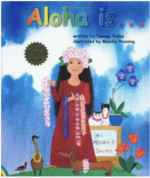 It was a desire deep inside of me to be creative. From childhood, I drew cartoons and wrote poetry for fun. At Island Heritage I wanted to try my hand at being a writer. The Creative Director suggested that I submit a manuscript. I came up with a little poem called, Aloha Is…,and it was accepted and published in 2006. To this day, it is still one of Island Heritage’s Best Sellers. This story is in rhyme and shares the many meanings of aloha. Illustrated by Rosalie Prussing, the pictures are absolutely a work of art! I wanted to write for the children of Hawaii to give them books about “us.” I was very lucky to be partnered with great artists that brought my stories to life. Their talents helped me share the beauty of our people, our values, our lifestyle and our home.
What do you enjoy most about writing for kids? What are some of your greatest challenges in writing for children?
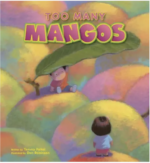 I really enjoy when the kids connect with my stories. Like in Too Many Mangoes, perhaps they have mangoes that they have shared with their neighbors or maybe they have a hard-of-hearing grandpa too. I am in awe when someone says that my book is one of their favorites. Never in my wildest dreams did I think that would ever happen! It makes me feel so proud that I can bring joy to others in my own little way. My greatest challenge would be coming up with an idea for a story. I want all of my stories to be upbeat and positive. I want to give a good message to the children and make them smile.
What are your hopes and dreams for the year and beyond in terms of your writing career and what you would like to see published in the future?
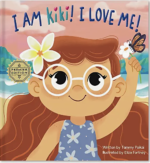 Right now I am just enjoying my latest book, I am Kiki! I Love Me! which just came out this summer 2022. The story begins with Kiki singing a song to herself on the beach of Hawaiʻi until a volleyball player teases her for being so short. Kiki loves herself and won’t let others bring her down. Illustrated by Eliza Fortney, the beach scenes are absolutely beautiful with lots to look at.
I have been waiting a very long time to have this story published. I love this story because I hope to inspire young children to simply love themselves the way they are and not let others make them feel bad about themselves. Also, I was able to add a little poetry in the story which is a fun touch for Kiki’s confidence.
There are not a lot of stories for or by Native Hawaiians and Pacific Islanders. Why do you think that is? What do you think we can do the change that?
We should always encourage people to share their own stories. Like my co-worker simply encouraged me to submit a manuscript, I thought it would be harder than that. Years, later I encouraged a friend to submit a manuscript, now she is a published children’s author at Island Heritage too.
What advice do you have for aspiring writers?
If I can do it, so can you! Write what you know about, what you enjoy, what you love, etc. Also, read it out loud to yourself, over and over again to make sure it is just right. Have a good message or moral if it is a children’s story. Take pride in your work!
Which of your books did you have the most fun writing? Which were the most challenging?
I enjoyed writing Too Many Mangoes, a story about sharing. Grandpa has so many mangoes that he asks his grandchildren to share the mangoes with the neighbors. Illustrator Don Robinson’s characters are so delightful. I was able to incorporate my family’s names in the story, and I really did climb my Grandpa’s mango tree when I was a child. By the way, my grandpa’s name was Mr. Wong, just like the in the story!
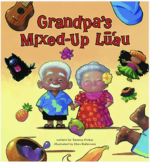 Which were the most challenging? I wanted to do a funny book with rhymes. Grandpa’s Mixed-Up Lūʻau is what happens when a lovable, but hard-of-hearing Grandpa tries to help Grandma get ready for a lūʻau. Also illustrated by Don Robinson, the story unfolds with his beautiful pictures. At first things were flowing nicely: “boy” rhymes with “poi,” “Malia” rhymes with “haupia.” But I struggled with a rhyme for “kalua pig.” Then inspiration came from above, “Canoe that’s big!”
What’s your experience with publishing your books?
It’s been excellent! The Creative people at Island Heritage, a.k.a. The Madden Corporation were not only professional but super creative and extremely talented. I’m sure it helped me by being a co-worker/friend to the Creative Department. Their website has not only my books but also they have beautiful Hawaiian themed gifts and souvenirs.
Where do you get ideas for your books?
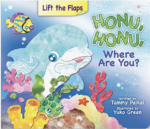 Honesty, I believe my inspiration comes from “above.” Something happens and the title pops in my head and the writing part comes easy after that. For example, one day my neighbor came to our house and asked if we saw her pet turtle that they lost. I thought to myself, Honu, Honu, Where are You? and then wrote the rhyme for that playful story about baby dolphin looking for his friend, Honu, the sea turtle. Yuko Green who cleverly illustrated the book using flaps to help hide the turtles in this story.
Another time, my daughter was telling me that she put capers in her salmon dish. I heard “papers” and questioned her about what kind of papers? She was annoyed, but I thought it was funny. So I came up with Grandpa’s Mixed-Up Luau.
Which characters do you relate with easily? Why?
Kiki would be the character that I most relate too. She is short, wears glasses and is happy-go-lucky. As a young girl my brother would tease me and I didn’t stand up for myself. I wrote Kiki wanting young girls to love themselves so that if others tease her, it would not affect her self-esteem. My daughter was working on a project a few years ago about empowerment for women of color. That project inspired me to write I am Kiki! I Love Me!
This is great, Tammy. Anything else?
Mahalo to my long time friend, Kamalani Hurley. I am so honored for her to share my humble story. Also, many thanks to the people of Hawaii for making me feel special and embracing my stories that I really loved writing. Dreams do come true, thanks to you!
Mahalo to YOU, Tammy! We look forward to many more of your stories for keiki! To contact Tammy Paikai and learn more about her books, please visit the Island Heritage website
Ka Maile, a Mele Aloha by Kahaulahilahi Vegas
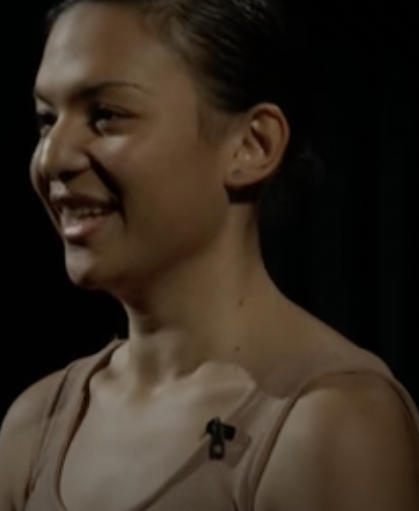
Native Hawaiians look to our kūpuna — our elders — to help us find our pathways through life. They guide us by their spiritual wisdom through personal, familial or community difficulties. Kūpuna are the source of experience, knowledge, guidance, strength and inspiration to the next generations, a rich resource to contribute to the betterment of the Hawaiian people.
Kahaulahilahi Vegas is a fluent Hawaiian language speaker whose family is from both Molokaʻi and Oʻahu. After graduating from Leeward Community College and the University of Hawaiʻi-West Oʻahu, Lahi is pursuing her PhD degree in Public Health at the University of Hawaiʻi-Mānoa. Her goal is to help the Native Hawaiian community.
Lahi Vegas also loves to compose. To honor her beloved kūpuna, she composed her mele aloha, Ka Maile, which we published at Pūpū A ʻO ʻEwa in 2015. She credits her grandparents for providing the foundation of her lifeʻs path. Lahi says she will always be inspired by her kūpuna: He aloha pau ʻole — a love without end.
Watch our interview with Lahi in both ʻōlelo Hawaiʻi and ʻōlelo haole. Mahalo nui, Lahi.