How I Learned to Write Using Mentor Texts: Unspeakable, by Carole Boston Weatherford

Books-unsplash
Books-unsplash
Photo by Fallon Michael on Unsplash

Welcome to a new occasional series about learning from mentor text picture books!

I love picture books, those wildly colorful, wonderfully imaginative works of children’s literature. Some picture books are so good that every time I read  one, I always come away with something new — a fact I didn’t know, an exciting idea I hadn’t thought of, a point of view I hadn’t considered — in a small, easy-to-read, beautifully illustrated package. As a writer, I use mentor texts to improve my storytelling skills. 

What are mentor texts?

These are well-written books we can use as models to become better readers and writers. Mentor texts allow us to experiment, to take risks, and to test new ideas and points of view.

Patrice-GopoThere is an army of us authors (and teachers, parents and grandparents, librarians, and students) devoted to and inspired by picture books. Just listen to the popular podcast Picture Books are for Grown-ups, Too led by my friend, the wonderful Patrice Gopo. Her guests are writers who discuss mentor texts, fiction and non-fiction, of all kinds.

Like these writers, I also study mentor texts to learn the tricks and tips to improve my own writing. I focus on HOW a story is told, including plot devices, page turns, and lyrical language. 

But what if I can’t find mentor texts about the topics I want to write about?

That’s the challenge I face. I write about my Native Hawaiian community’s difficult history, and mentor texts on our generational trauma written by ‘ō’iwi authors are pretty much non-existent. 

If, like me, finding mentor texts for your difficult topics is a struggle, it may help to realize that our communities are not the only ones that face historical challenges. Picture books by successful kidlit authors such as Carole Boston Weatherford, Traci Sorrell, Rob Sanders, Sun Yung Shin, and others can inspire and instruct us. 

That’s what this series is about — the search for mentor texts that demonstrate ways in which difficult / sensitive topics can be handled with care yet honestly for young readers, and thus inspire us to write our own stories. 

Which mentor text inspired me to write my own picture book stories?

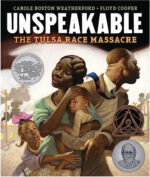
Unspeakable coverFor me, the influential picture book that helped me to write my first two non-fiction manuscripts is UNSPEAKABLE, THE TULSA RACE MASSACRE by Carole Boston Weatherford (Lerner, 2021.) In fact, I love this book so much that I chose it to speak about when I was a guest on Patrice’s podcast.

The book makes this difficult history story accessible to kids. Ms. Weatherford does this in deliberate, ingenious ways:

  • employing the familiar refrain, “Once upon a time,” to gently orient readers to the city and the residents’ accomplishments, 
  • making use of measured yet musical language, such as internal rhyme and alliteration,
  • incorporating the everyday activities of residents with the names of actual businesses, such as the soda fountain at Williams Confectionery, making the story more relatable to today’s young readers,
  • presenting the inciting incident with the words, “All it took,” a devastating moment in the book,
  • choosing words that demonstrate the violence of the mob, resulting in a clear-eyed telling that never condescends or insults the reader’s intelligence,
  • ending with a call to action and a scene of hope. 

Because I’m such a fan-girl, I contacted Ms. Weatherford through her website to thank her for her incredible book. Her response was a gracious email encouraging me to stick with it:

Thanks so much for reaching out. I love Hawaii but hate what was done to the indigenous people. Please document that history.

Absolutely!

My-guest-podcastWhat are your mentor texts? Are you working on difficult, challenging topics? Which picture books inspire you? Email me kamalani3@gmail.com and let’s talk books! 


Interview with Native Hawaiian Artist Solomon Enos

Solomon-Enos

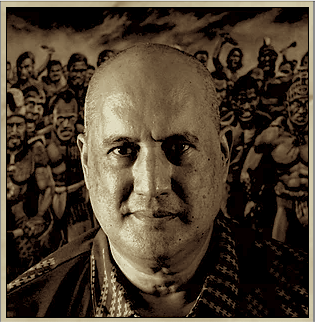
Native Hawaiian artist Solomon Enos is a modern-day Renaissance man: a sought-after artist, book Solomon-Enosillustrator, muralist, sculptor, and game designer. His beautiful pieces have been exhibited at multiple public venues, including the Honolulu Museum of Art, the Hawai’i State Art Museum, and the prestigious Smithsonian Museum Asian Pacific American Center. Google, Pixar, and Disney’s Aulani Resort are among his famous clients. 

His website describes the artist this way:

A self-described “Possibilist” Solomon’s art expresses an informed aspirational vision of the world at its best via contemporary and traditional art that leans towards Sci-Fi and Fantasy. His work touches on themes like collective-consciousness, ancestry and identity, our relationship with our planet, and all through the lens of his experience as a person indigenous to Hawaiʻi.

Yet for all his many accomplishments and contributions to the community, he is a humble man of few words. We are honored to feature the artist, Solomon Enos.

Aloha e Solomon. For those who haven’t met you yet, can you please tell us a little about yourself?

FamilyI am a native Hawaiian artist with an interest in visually translating aspects of Hawaiian culture into new media and genres. 

Where did you grow up? What high school did you grad from?

I grew up in Mākaha [island of Oʻahu] and went to Waiʻanae High School.

Go Seariders! Who are your biggest supporters?

My family and associates who share a sense of kuleana to our cultural values.

Why did you come an illustrator/artist? Did you always  know you could create art? 

From a very young age, as my family gave me all the encouragement I needed. 

What do you enjoy most about creating art? What are some of your greatest challenges? 

The very mystery of creation, and finding enough time to work in balance with my other responsibilities.

Liliʻu-Kalākaua-MuralWhere do you get your inspirations?

From a multitude of varied sources and quite a bit of internal explorations.

Illustrators and artists, like writers, do a lot of research when theyʻre creating. Whatʻs your research process like? 

This is probably the most challenging question, as I am constantly working and creating, so I do not separate my process from my daily life. To sum it up, I have an unstoppable belief that I can achieve any vision I set out to create, providing I manage my time, as I have multiple visions in progress.

What beliefs are your work challenging?

The nature of war as inevitable, and the worship of wealth without responsibility.

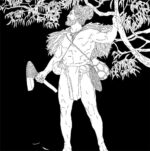
Gatherer-black-and-whiteThere are not a lot of Native Hawaiian, Pacific Islander or people of color illustrators.  Why do you think that is? What do you think we can do to change that? 

I am very much committed to inspiring other natives, by example of my work ethic, and my aspiration to gain consensus as I move to excellence.

What are your hopes and dreams for the year and beyond in terms of your artistic career?

I am blessed to be working on a range of major commissions simultaneously, and I hope to get back to my own projects with all this gained experience.

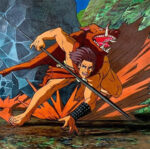
Art-AttackCan we see a bit of your current work?

Sure, @solomonenos on Instagram is the most current and easiest way to access my work.

What advice would you give an aspiring artist? 

Make sacred work spaces, where you have all your tools and good lighting. Know that whatever you are currently working on, it is the most important thing you can be doing with the time you have to give. Be fearless and take risks with paper and canvas, and no time used creating is ever wasted.

What’s your online presence like? Do your followers contact you? What do they say? 

Solomonenos.com, and I am most actively on Instagram @solomonenos. I absolutely encourage engagement and conversations, and I have been blessed with many people expressing their appreciation and who have found inspiration in my work. Those are truly the priceless ways that I thrive and can give back. 

Mahalo, Solomon, for sharing your mana’o with us today, and best wishes always for your continued success!

To learn more about Solomon Enos, including his online portfolio of murals and exhibitions, visit his website, SolomonEnos.com. Photo and images courtesy of Solomon Enos


Book Review: Lei and the Fire Goddess, by Malia Maunakea

Lei-and-the-Fire-Goddess

Lei-and-the-Fire-Goddess

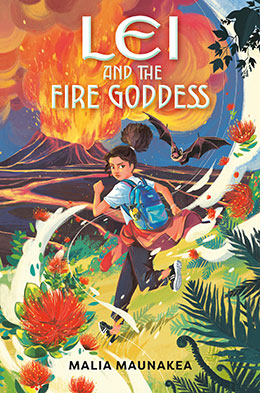
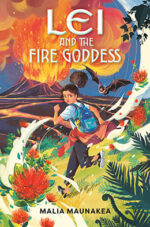
Lei and the Fire Goddess by Malia Maunakea is a rare gem in kid lit: an epic coming-of-age story written by a Native Hawaiian author featuring Native Hawaiian characters.

The story introduces us to twelve year old Lei, with all the joy and snarkiness and insecurity that are part of growing up. It didn’t take long for me to get into the story. From the very moment she steps off that airplane at Hilo airport, Lei is a fully developed, fully likeable character.

So are the secondary characters, especially Tūtū, ʻIlikea, Moʻo, Kamapuaʻa, and the formidable Pele. I won’t spoil it for you by revealing too much. Just know that the characters of Hawaiian legends come alive in the author’s vivid storytelling and are integral to Lei’s growing awareness and maturity.

There is so much I love about this book.

I loved Lei’s character arc, watching her grow, facing her fears, devising solutions, and facing the consequences. The exciting major scenes — between Lei and Kamapuaʻa, between Pele and Poliʻahu, the holua sled race — grab the reader and donʻt let go.

But even the quiet moments, such as Lei vowing not to share the waterfall on social media and later realizing why telescopes donʻt belong on Maunakea, speak volumes,  especially to ʻōiwi readers.

I love how the language is geared to today’s audience without being dismissive of the memories and upbringing of the older readers the story might appeal to. The ʻōlelo Hawaiʻi is not a trope but a real storytelling device. For example, Tūtūʻs “close the mouth” line in an early scene is such a Hawaiian way of teaching and learning.

I loved what felt like inside jokes but are really evidence of the author’s authentic voice: KTA, the tin roof, Iz’s song, li hing mui snacks, pidgin. I love that the first hula that comes to Lei’s mind is the one we all learn as kids, Kahuli Aku. And I laughed out loud at the chapter titled “Ma-ke Die Dead.”

Now the elephant in the room. At first I was super nervous about Pele being a main character. Our kūpuna teach us to respect and revere her. There will always be traditionalists who feel the Pele story should never be retold in a modern voice.

Yet, for me, more than anything, I love how creative the story is. It’s respectful and authentic and adds to the Pele and Kamapuaʻa canon for today’s kids. Pele truly sounds like the goddess I grew up hearing about. That she becomes Lei’s frenemy is edgy and feels right. 

Kids’ books by lived experience/own voices authors are so important. I am Native Hawaiian and grew up in the 1960s. There were no books – not one! – where the characters looked like me, did the things I did as a kid, ate the foods I ate, or used the pidgin I spoke. All kids deserve to see themselves in children’s lit.

This is why books like Lei and the Fire Goddess are so important. It’s a beautifully written, rollicking exciting-scary-funny story that kids everywhere will love. For all these reasons, LEI is a must-read.

Lei and the Fire Goddess  
By Malia Maunakea   
Penguin Random House
2023
ISBN 9780593522035
Suggested for ages 8 – 12

Mahalo to Sierra Pregosin at Penguin Random House for access to the galley! 

Learn about author Malia Maunakea in our talk-story interview. To look up the definitions of the Hawaiian terms used in this post, please visit Wehewehe.org


Interview with Native Hawaiian Author Malia Maunakea

Malia-Maunakea-Kahiki-Photography

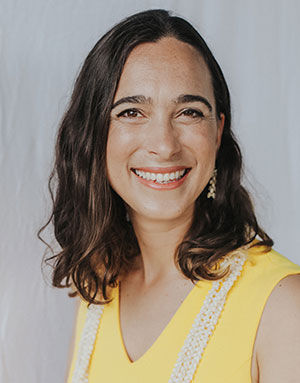
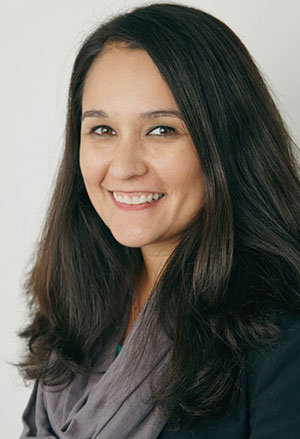
Malia-Maunakea-Kahiki-PhotographyMalia Maunkea is Native Hawaiian author of middle grade and non-fiction. Her new novel, LEI AND THE FIRE GODDESS, a rollicking story about an adventurous Native Hawaiian twelve-year-old, is a rarity in childrenʻs literature: a story for middle grade kids written by an ʻōiwi author that features an ʻōiwi character. We are proud to feature Malia in todayʻs talk-story.

Hoʻomaikaʻiʻana on your new novel! For those who haven’t met you yet, please tell us a little about yourself.

Sure! My name’s Malia, named for the Olomana song O Malia since my parents’ first date was to an Olomana concert. My mom is from upstate New York and is pure Polish. My dad is from Māʻili (West Side) on Oʻahu. I’ve been married to my awesome partner for nearly two decades, and we have two kids who are teens at the time of this interview. I love hiking and backpacking and traveling around the continent in our tiny campervan.

Where did you grow up? What high school did you grad from?

I grew up on Hawaiʻi Island ’til 7th grade and Oʻahu thru high school. I got accepted into Kamehameha Schools in 7th grade. I was a boarder for one year, then my family moved over to Oʻahu and, much to my dismay, I had to move back in with them. I graduated from Kamehameha Schools in 1999. My dad is class of ʻ72. My great-grandpa is class of ʻ17.

I mua! Go Warriors! Can you share a bit of your upcoming debut novel, LEI AND THE FIRE GODDESS? Without giving too much away, what is it about? 

Lei-and-the-Fire-GoddessLEI is about a girl who is raised in Colorado but goes to stay with her tūtū in Volcano, Hawaiʻi every summer for three weeks. She’s part Hawaiian but doesn’t feel like she’s Hawaiian enough to fit in there, and she also struggles fitting in back home in Colorado where no one believes the things her grandma tells her.

This summer she decides she doesn’t believe them either, and all she wants to do is go do touristy things so she can have fun stories to tell her friends when she gets home. Unfortunately, Lei ends up insulting Pele, the fire goddess, who sends her giant hawk to kidnap her best friend. When Lei goes to rescue him, she realizes just how real Tūtū’s moʻolelo are as she teams up with demigods and talking bats to battle mythical creatures and evade the traps Pele hurls her way. For if Lei hopes to get her friend back, she has to dig deep into her Hawaiian roots and embrace all of who she is.

That’s an exciting idea! What inspired you to choose that topic for your debut novel? 

My son was big into Greek mythology for a while, and I tried explaining to him that we Hawaiians have our own amazing gods and legends, but he sorta brushed me off. I decided the only way I could get him to listen was maybe if I put it in a book that could be on a shelf that his classmates might pick up and read, like a Percy Jackson type story. So I came up with this story to try share a lot of the myths and moʻolelo I learned growing up in Hawaii with a new generation of readers who may or may not be familiar with our stories.

What was your favorite part of writing your novel? What was most challenging? 

My favorite part was going back through my memories and pictures from living in Volcano and visiting Hawaiʻi Volcanoes National Park and remembering all the iconic art and songs that I was able to thread throughout the story. The most challenging was bringing it up to speed. Things have changed since I moved from the island, and I wanted to make sure I was still on point with various landmarks and understandings.

What characteristics do you love best about your protagonist, Anna Leilani Kamaʻehu? Is she modeled after someone specific? 

I love that she’s sort of a jump-right-in-and-figure-it-out-as-we-go kind of a person. I pulled a lot of my own struggles of not feeling Hawaiian enough and difficulties making and keeping friends as material for Anna.

What was the journey to getting your novel published like? How long did it take to write your book?

I drafted this book from April to August of 2020 then spent two years in revisions. My journey was super fast compared to some folks, and not as fast as others.

In the fall of 2020 I applied for a number of mentorships and ended up being selected for both We Need Diverse Books (WNDB) and my regional Society of Children’s Book Writers and Illustrators (SCBWI) programs. I worked intensively with Alan Gratz and Andrea Wang to rewrite, revise, and improve my story from January to May of 2021, then submitted it to #APIPit (a pitch event on Twitter) in May of 2021. I received interest from a number of agents, so I sent out my queries and interviewed different agents, selected an agent, did more revisions, sent the book out on submission to publishers in June, ended up having multiple publishing houses interested and went to auction in August.

We sold in September 2021 in a two book deal and started working with my fabulous editor Elizabeth Lee at Penguin Workshop (an imprint of Penguin Random House). So since then it has been many more rounds of revisions, and now working on book two!

Why did you become author? Have you always wanted to be an author? 

I loved writing when I was young but was advised by teachers that it wasn’t necessarily my strong suit and that I was better at the maths and sciences. I also loved reading but abhorred book reports and most of the required reading from my classes. It wasn’t until I was an adult with a couple of careers under my belt when I popped my head up from the grind and wondered if it was possible for me to try writing again.

We are so glad you did. What do you enjoy most about writing, especially for kids? What are some of your greatest challenges? 

I love writing exciting, fast-paced action scenes—showing kids how clever and strong and brave they can be. My greatest challenge is to get the characters to have an arc, to have them change over the course of the story. A mentor told me once that people don’t fall in love with plot; they fall in love with characters. The character needs to be three dimensional and flawed, so readers can root for them and understand why they’re going through what they’re going through. That is challenging for me as I usually come up with fun circumstances that I want to have happen to my character, but they usually don’t tie in to a theme or deeper meaning (which probably ties into why I struggled with Language Arts and book reports in school.)

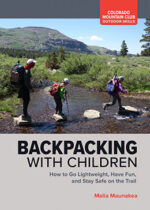
You also wrote another book, BACKPACKING WITH CHILDREN book, which is on a very different topic. What made you decide to write this book?

Backpacking-with-ChildrenI actually started that one before LEI AND THE FIRE GODDESS. A friend of mine published a book for beginner backpackers, and I thought that if he could do it, I could do it. They say to “write what you know,” so I wrote about my experiences backpacking with our kids over the past ten years and 600+ miles. While that book was on submission, I had a lot of time to wait, and so I decided to write the next thing, and the next thing, and then another thing. And that last thing ended up becoming LEI!

What are your hopes and dreams for the year and beyond in terms of your publishing career and what you would like to see published in the future? 

I have so many ideas and not enough time! I’m working on revising the sequel for LEI right now and working on a young adult contemporary novel that I describe as Pride and Prejudice meets WILD. I’d love to do well enough that I’m able to get back to Hawaiʻi and spend time with keiki in the schools there.

Hopes and dreams? How big you want to know? Heck, if we go big time, I’d love for someone like Dwayne Johnson or Jason Momoa or Barack Obama to pick it up (they all have daughters and probably other kids that they could gift it to after they’re pau reading) and talk about it so that it gets on the radar of Taika Waititi and scooped up into a movie. Then some mysterious benefactor who is looking to give back to kānaka in Hawaiʻi offers to give a copy to every kid in Hawaiʻi (so many times growing up I never had money to get a book at those book fairs) and rents out the movie theaters so all the kids and their families can go see it for free. 

Clearly I’m not realistic when it comes down to the fact that this is a business since I want to just give it all away. I’d absolutely love to have a long, steady career in writing, but even if LEI is the only fiction book I ever sell, it’ll have been an incredible experience.

I love your big dreams, Malia. What beliefs are your work challenging?

I’m not sure if this is challenging beliefs, necessarily, but I’m trying to do a couple things with this story:

  1. Help kids who might not feel like they are representative of their own cultures or ethnicities understand that they are enough and
  2. Help increase awareness of some of the issues Hawaiians are facing in an age appropriate way that doesn’t feel overly teachy/preachy— mentioning the day the Hawaiian flag was taken down from ‘Iolani Palace, by mentioning the telescopes on Maunakea and protection efforts there, having Anna face discrimination by a local girl when she doesn’t pick the right sticky rice at the grocery store.

Do you have any experiences as a Native Hawaiian writer that you might share with our readers? What would you like to see change in the industry regarding the acceptance of BIPOC creators? 

Our voices are so important! The way we view the world, interact with nature and our families, process trauma, and perhaps come from a more collectivist culture (prioritizing the group above the individual) are all so different than experiences traditionally portrayed in stories.

Some of us don’t follow traditional western storytelling patterns, and that’s okay! I’m really excited about some new up and coming Kanaka authors, like Makana Yamamoto’s Hammajang Luck and Megan Kakimoto’s Every Drop Is A Man’s Nightmare and your own Kahoʻolawe! All of our stories are important, and it’s necessary for a plethora of us to have our voices out there so none of us is burdened with representing the entire lāhui, the entire Native Hawaiian population. We are each so unique within our shared experiences, it is critical that readers are able to see Hawaiians as individual flavors, not just all coconut all the time.

What advice would you give an aspiring writer? 

Find other writers to learn with, practice with, and commiserate with! If you love it, it isn’t a waste of time. If your strengths lie elsewhere, you can do both! Keep this as a hobby as you explore other things as well.

Is there a fun fact youʻd like to share about yourself with young readers? 

Hmm, one of my earlobes is attached, and the other isn’t. Oh, and I have a preauricular pit on one ear. And I get random songs stuck in my head a lot of times and end up making epic mash ups of songs but can never remember any of them. Otherwise, I’d have been an awesome DJ.

What kinds of books do you enjoy reading? Any favorites? 

As a kid I loved Garfield and The Far Side (I probably would have devoured graphic novels if they’d been around!). Then I got into creepier things, RL Stine to Christopher Pike to Stephen King (it was quite the jump, but there weren’t many young adult options that I knew of way back in the 1900s). Now I love reading funny, action-packed middle grade stories and young adult or adult rom-coms with strong female leads and lots of witty banter. I go through them too quickly to remember a favorite!

Do you have an online presence? Do your readers contact you? What do they say? 

My website is MaliaMaunakea.com, and on social media I’m on Instagram and Facebook. My book wasn’t out then, but I did some virtual classroom visits in February and read a couple chapters of my book to kids, and a number of the classes sent me thank you notes. Oh, my goodness, my heart was not prepared for the sweetness and loveliness of their expressions. They are why writing for kids is the best thing ever. 

It was so much fun talking story with you, Malia! Mahalo nui loa for sharing your mana’o with us! E pili mau nā pōmaikaʻi me ʻoe (best wishes!)

To read more about Malia, including her cool list of fun facts, visit her website, MaliaMaunakea.com. Photo credit: Kahiki Photography


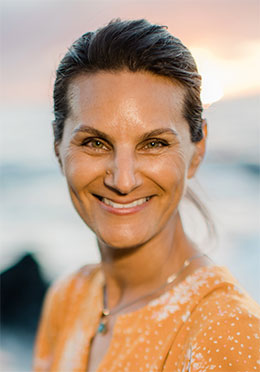
Interview with American Library Association President Lessa Pelayo-Lozada

Lessa Pelayo-Lozada

Lessa Pelayo-LozadaPresident of the American Library Association, Native Hawaiian Lessa Kananiʻopua Pelayo-Lozada is a warrior. With politicized book bans on the rise, the nation’s librarians battle to protect intellectual freedom. Lessa works to strengthen the ALA’s commitment of keeping the nation’s libraries as safe spaces that offer everyone — regardless of their socio-economic status — free and equal access to news, information, and education. The fight is daunting, but Lessa and are all in:

We are resisters at our core. We protect all our patrons, uphold intellectual freedom, and serve our communities. Yes, the wins we see every day are a reward, but knowing that we have resisted for yet another day and continue to provide that safe space is a reward in and of itself for me, and I hope for all of you as well.  — Lessa Pelayo-Lozada, American Libraries Magazine

Lessa is the first Native Hawaiian/Pacific Islander to be elected president of the ALA. She is also the youngest person ever elected to that position. We are grateful that this hard-working, dedicated leader made some time to talk story with us. 

Congratulations on your election to president of the American Librarians Association! For those who haven’t met you, could you please tell us a little about yourself?

I am a mixed-race, continent born and raised Native Hawaiian woman from Southern California. I’ve been in public libraries since 2007 and have worked as library page, clerk, Children’s Librarian, Teen Librarian, and now am the Adult Services Assistant Manager at the Palos Verdes Library District in Southern California.

I am the current President of the American Library Association and am a past President and Executive Director of the Asian/Pacific American Librarians Association. I have also served as a board member for the Center for the Study of Multicultural Children’s Literature for the last ten years and contribute to our best books list annually.

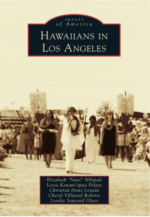
I used to dance hula for Kaulana Ka Hale Kula ‘O Nā Pua ‘O Ka ‘Āina in Torrance, California, and am a current member of the Hawai’i’s Daughters Guild of California. My husband, Christian Lozada, and I co-authored the book Hawaiians in Los Angeles from Arcadia Press.

Where did you grow up? What high school did you grad from?

I’m born and raised in Southern California, in the cities of Torrance and Gardena. I went to Bishop Montgomery High School in Torrance.

Go Knights! Have you always wanted to be a librarian? When did you realize that being a librarian was your calling?

Originally I wanted to be an elementary school teacher, teaching either kindergarten or second grade. While I was working at Borders Books, I met a number of librarians from the Los Angeles Public Library who showed me that librarianship was a viable career path – one I thought I would follow after I would spend time teaching. After two days in the teacher credential program, however, I knew for sure that librarianship was my calling and started working as a page that same summer and have never looked back!

What made you decide to run for the ALA’s highest office?

Two things:

First, as an ALA Executive Board member from 2017–2020 and chair of the Steering Committee on Organizational Effectiveness from 2018–2020, I identified the need for ALA’s structures to change and become more nimble in today’s changing world. The work I began as an EB member I hoped to finish as president, and I am happy to say that we have gotten a number of things accomplished during my year, such as modernizing the ALA bylaws which will go to a full member vote this spring.

Second, the pandemic and all the ways that library workers were showing up for their communities inspired me to run for President. As a front facing library worker, I saw all the ways that we needed ALA to show up for us, but as someone who understands the capacities of ALA, I also knew that the current structure couldn’t support the labor needs of library workers. I ran to push the envelope in working on fortifying the ALA structures that can support these needs, such as the ALA-Allied Professional Association, a companion organization to ALA. Although the process has been slow, we’ve been making progress in this realm.

What are some of the biggest challenges that librarians face today?

The biggest challenge facing libraries, library workers, and librarians today are book challenges. The unprecedented number of book challenges and the toxicity and harassment of library workers around these book challenges is creating difficult and impossible working conditions for many across the country. To help combat book bans, I encourage folks to visit uniteagainstbookbans.org and explore ways they can fight back. We can’t do this alone as library workers – we need the public to join in this fight!

What are your greatest strengths that you bring to the ALA and its membership?

One of the greatest strengths I bring are my values of kuleana and kōkua. My commitment to library workers and libraries is rooted in these two values and help me to keep perspective on the long road ahead towards being spaces of lifelong learning, education, and true inclusion when it comes to access to information and I believe allow me to communicate a specific vision that can be shared by ALA members everywhere.

I also can facilitate a great meeting and work hard to ensure all voices and necessary stakeholders are included in decision making, modeling the inclusion that I hope we all embrace.

What do you enjoy most about being a librarian?

Learning new things! Whether it is learning something through a reference interaction, learning a new song for story time, or learning another person’s story, it’s impossible to get through a day as a librarian without learning something new – and something you might not have sought out to learn on your own!

During your campaign, you received many endorsements. What does this recognition mean to you?

The number of endorsements and support I received during my campaign was a huge honor and a testament to the relationships I try to develop in doing work on behalf of the association. Even if I didn’t win the presidency, knowing that I had all of those people to do great work with in the future, and have done great work with in the past was a big win.

Can you share a bit of your current work?

Right now I am focusing most of my time on my role as ALA President which includes being the primary spokesperson for the association, chairing the Executive Board and Council, and working with ALA members and committees to figure out the path forward around book challenges.

The role of spokesperson is a big one, as it includes media interviews like the one I did for Teen Vogue as well as traveling the country and internationally doing keynote speeches and speaking on panels like I did when I visited Hawai’i for the Hawai’i Library Association Conference and Centennial Celebration!

I am also a member of the program committee for the International Indigenous Librarians Forum to be held in Honolulu this November. I hope folks will join us!

What advice can you give someone who might be consider studying library science?

Be firm in your “why” – why you want to work in libraries and what kind of impact you want to make. It can be a difficult field when book challenges, continued budget cuts, and hierarchical bureaucracies can prevent you from doing your job, but recognizing the impact you have, can, and will make on your communities can help keep you motivated.

I also always encourage folks to be open to the myriad of opportunities available in libraries. There are so many paths you can take and you don’t always know what they all are when you start in libraries, so be open to new opportunities and experiences you never thought possible. That kind of mindset helped me to become ALA President.

And a few niele questions, if you’d like to answer:

Who is your hero?

I have a lot of heroes! My grandfather and grandmother, Alcario  and Mary Pelayo, are my primary heroes. They modeled and inspired me to live a life of service and leadership and supported my many, many interests growing up, even if they didn’t always understand them.

Who is your biggest supporter?

My husband!

What is your proudest accomplishment?

Putting on the 2018 Joint Conference of Librarians of Color as a Steering Committee Member.

What do you enjoy doing in your down time?

Baking, exercise, hiking.

Where can readers find you online?


Mahalo nui loa, Lessa, for sharing your manaʻo with us! As an author, life-long learner, and library patron, I offer my best wishes to you for your continued success!

Interview with Award-Winning Author Rukhsanna Guidroz

Rukhsanna Guidroz
Rukhsanna Guidroz
Rukhsanna Guidroz

Award-winning author and Maui resident Rukhsanna Guidroz has always lived life on her own terms. Born in England and educated at the Sorbonne in Paris, Rukhsanna has been a world traveler, journalist, radio producer, and now, teacher. Her books feature plucky female characters in stories that charm and delight young readers…and their adults, too.

Hi, Rukshanna! For those who haven’t met you, could you please tell us a little about yourself? 

I am an educator and writer. I moved to Maui from Hong Kong in 1996.

Where did you grow up? 

I grew up in Manchester, England, and graduated from a small private school outside the city. Manchester has cold, wet, grey winters. I remember the sunny days being such a welcome surprise. I went to Seattle in March last year, and the crisp, cool weather was familiar to me. Even though I’ve lived in a warm climate for 30 years, my body still remembers cold temperatures. I don’t think I could live anywhere else but Hawaiʻi now that I’ve been spoiled.

Who is your biggest supporter? 

My husband is one of my biggest supporters. Writing and forging a path as an author can be a long, lonely endeavor. There have been many times when I’ve considered giving up and moving on. My husband has always believed in me and encouraged me through uncertain times. 

Why did you become a writer? What inspired you to write for children? 

I have always enjoyed writing. In middle school, I wrote a poem that ended up being published in the school magazine. I never considered pursuing writing as a career, but there was something in me that felt the need to write that poem. It was a channel through which I could freely express myself. There came the point in my life when I felt I needed more than just writing stories for myself. I started seeing the stories in book form. When writing wasn’t enough, I knew I was ready to begin submitting my work to agents and editors.

As a teacher and tutor, I have always enjoyed being with kids. Spending time with them allows me to see the world through their eyes. When you put yourself in someone else’s shoes and perceive the world around you, it’s incredible what you see. 

What do you enjoy most about writing for kids? What are some of your greatest challenges in writing for children? 

Mina-and-the-MonsoonWriting for kids allows me to be a child again. Our youthful years are often spent working out our place in this complicated world. Feelings can be mixed up and confusing. We are trying to understand who we are and where we belong. That vulnerability is a universal theme. It’s what we all share as human beings, no matter where we live or what situation we were born into. For me, it’s a rich ground for exploration and story.

My most significant challenges are staying in their youthful space and not returning to adult life before I finish my work. Remaining in character as I write can be tricky. I have to constantly remind myself who I am and what drives me as a character in the story. I have found tricks to help me, though. Taking breaks for tea, a stretch, or a walk helps me. Changing the font in my document can feel like I’m reading a peer’s work, not my own. That distance allows my constructive voice to come through and spot areas that need adjusting. 

What are your hopes and dreams for the year and beyond in terms of your writing career and what you would like to see published in the future? 

I would like to think I could be a prolific writer and write book after book. That’s not me. I wish it were, though. I want to write a children’s fantasy novel at some point. The idea frightens me because it’s a genre I’ve never written in, and maybe the challenge is what attracts me. Starting my next project is always refreshing, exciting, and intimidating at the same time. 

I would love to see more books out there by marginalized voices. Those little unknown stories are precious gems and much needed in our world. I think it’s essential for our children to see themselves in books so they can feel valued and validated. Literature has the power to do that.

There are not a lot of stories for kids by writers from your community. Why do you think that is? What do you think we can do the change that? 

I have never met anyone who is Indian-Chinese. It took me many years to realize that being seen as unique or unusual is not negative. As a person of mixed heritage in England, I always felt like an outsider. But now that I appreciate my identity, I see the possibility of many stories.

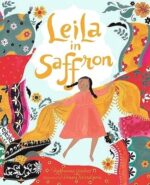
Leila-in-SaffronIt takes courage to write, and then, of course, you have to find a way to publication, whether it’s traditionally or self-publishing. On your way to publication, you have to find people who believe wholeheartedly in you and your work. The publishing industry has been dominated and still is by white people. When brown and black people fill some of its key positions, perhaps there will be more books that reflect the true diversity of this world.

Can you share a bit of your current work? 

I am currently working on a picture book biography about a chef. Food was such an important part of my childhood. It brought the family together, whether we were having a good or bad day. It was an equalizer and neutralizer. My mother embraced my father’s Indian/Pakistan roots, and our meals were mostly comprised of ingredients and dishes from his culture. My sister and I had a favorite dish we loved to cook. Growing up, we ate a lot of Chinese food, and dim sum was a favorite Sunday. Writing a book about cooking came naturally to me.

Which of your books did you have the most fun writing? Which were the most challenging? 

Writing each of my books was a different experience. When I wrote Mina vs. The Monsoon (Yali Books) I had fun crafting a story about a quietly persistent girl who is passionate about soccer. Imaging the scenes of this story were especially fun because I had many colors and their tones in mind, and the illustrator who created the artwork perfectly captured the feel I wanted.

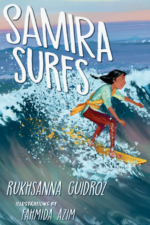
Samira-SurfsMy novel in verse, Samira Surfs (Penguin Random House) is about a Rohingya refugee who finds peace and empowerment in an all-girls surf community. It was probably the most challenging writing because I had never written a novel-length story. It is also a historical story, and I spent nearly two years researching the political and social aspects of the contextual setting. It stretched me as a writer, but I learned much along the way.

What beliefs are your books challenging? 
My books challenge the idea of limitations on girls. I didn’t set out to write about this theme, and I didn’t realize it was so important to me until I started writing. I believe it’s vital that any human being who wants to express their voice should have the avenues to do that. Girls and women are often overlooked in work, sports, and educational arenas.

In my second picture book, Leila in Saffron (Simon & Schuster) young Leila comes to appreciate who she is through self-discovery. It’s a story of female empowerment, although it can apply to boys or anyone unsure of their identity. I think my biggest compliment would be if even one girl is inspired to speak up after reading one of my books.

What’s your experience with getting your books published? 

Writing books can be an exercise in opening your heart and surrendering. Once a publishing contract is made, the author has to let go of complete control of the book. A whole team of people comes on board, and the project then becomes a collaboration with an agent, editor, illustrator, art director, etc. I have had positive experiences with my work and can only speak to the value of working with professionals who know how to shepherd a book from idea to bookshelf.

Do you have a website? Are you on social media? Do social media play a role for you as an author? Do your readers contact you? What do they say? 

I have a website and social media accounts, so my readers can find and engage in my work further. I was reluctant to go so “public” at first, but I see the benefits of being visible worldwide. I have received some enthusiastic emails, tweets, and posts, which always brighten my day.

What advice can you give an aspiring writer? 

Never give up. Work on your craft and find other writers. Build a community, join one, and get involved in a critique group. Writing is a solitary activity and can lead to long lonely periods indoors. Often in my break with friends or out in nature, I’ll find inspiration, a way through a block, and a word or phrase that was eluding me. Do anything you can to savor and refine your creativity. 

Thank you, Rukhsanna, for a sharing your work and your manaʻo with us! 

You can learn more about Rukhsanna Guidroz by visiting her website and following her on Instagram and Facebook

Interview with Polynesian Illustrator Shar Tuiʻasoa

Shar-Tuiasoa

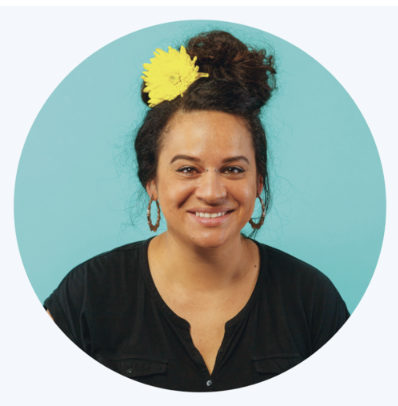
Talented Polynesian artist, illustrator and designer, Shar Tuiʻasoa is the creative force behind the hugely popular Punky Aloha Studio. Following graduation from Kailua High School (Go Surfriders!), Shar pursued a degree in fine art in California Shar-Tuiasoabefore returning home to Hawaiʻi.  Best known for her beautiful images of Polynesian women, Shar’s graphic illustrations are bold, colorful and always exciting. 

Aloha, Shar! For those who haven’t met you, where did you grow up? 

I grew up in Kailua on O’ahu, and it is where I live today with my ‘ohana.

Who is your biggest supporter?

My partner, my husband, my sidekick, Keali’i. He has stood by me through this crazy roller coster. From day 1.  He helped me get through college, he helped find my way back to me. When I first started Punky Aloha, he helped me pay for my business license and for my first business cards and prints. I guess you could say he was an early investor.  He helped my run my shop in the very beginning, and still helps me install murals to this day.

Why did you become a artist? What do you enjoy most about creating art?

Surf QueenI have always wanted to be an artist. I don’t know that I ever thought about being anything else. And that’s not to say that I was always good at drawing, because I definitely wasn’t. Haha! That took a lot of years of hard work.  But I grew up watching my mom draw. She is a wonderful illustrator and painter, and she raised us up surrounded by art.

I think what I love about making art the most is just being able to create the world that lives in your head. It’s almost like having a bit of control over something in your life. Even if it only exists on paper, being able to share your visions with people can be empowering and healing.

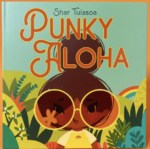
You also wrote and illustrated a picture book. What inspired you to write your first book?

Punky AlohaAs an illustrator, I think many of us have making a children’s book on our bucket list. I know I did. So when I was presented the opportunity, I went with what I knew best: me. I based my book on my childhood and what some of my experiences were like.

What are some of your greatest challenges in writing?

I don’t consider myself to be as strong a writer as I am an illustrator, so I came across a lot of challenges, especially writing for children. I wanted to go on this epic adventure with my protagonist, but you only have 32 pages and 800 words to do so, and you also have got make sure you remember who your audience is — 3–7 year olds! So it presents all sort of challenges but also opportunities in finding new ways to tell a story.

What are your hopes and dreams for the year and beyond in terms of both your art and writing career and what you would like to see published in the future?

My older brother is a very talented writer. He went to film school and has this really great comedic way of storytelling. We have been talking about working on either a graphic novel together or maybe a children’s book. Something. So that’s in my mind a lot right now. Ive also got a couple ideas brewing, so we shall see what the future holds. An ultimate dream of mine would be to have an animated series based on my books with a full pasifka and local to Hawai’i cast! Pasifika showrunner, editors, animators, voices, etc!

That would be amazing! There are not a lot of books for kids by Native Hawaiian and Pacific Islander writers. Why do you think that is? What do you think we can do the change that?

There aren’t, sadly 🙁 In fact, Punky Aloha was the first children’s book published by a big main stream publisher that was written and illustrated by (and starred) a Pacific Ulu MamaIslander. I didn’t realize that until it came out. And I think the lack of representation is something that is finally being addressed more and more.  On one end the media very rarely gives us a platform, so if we aren’t seeing ourselves represented, why would we even think we belong in certain spaces? So I think its a partnership in a way. We as PI and NH (Pacific Islander and Native Hawaiian) should feel inspired to take up creative space, and we should do what we can to learn those skills so that we can share our stories with our voices. Also, these creative platforms should keep looking out for all the talent we have to offer because there is A LOT! I always say: Greet opportunity with preparation. So when there is an opportunity for you to share your creativity, be sure you are prepared with a strong voice and a strong skillset! We got this!

We do! Do you have a website? Do you blog? When did you get started on social media? What do your readers say?

I do 🙂 www.punkyaloha.com is where you can find my portfolio of work, info and shop. I started my social media presence around 2018.

Lanikai DiverWhat advice can you give an aspiring author/illustrator?

My advice is to keep going! Keep working at what you are doing and most importantly, create work that you love. If that is what you are putting out into the world, that is what you will be hired to do.

What beliefs is your work challenging?

I like to challenge what our PI stereotypes. I have always tried to illustrate our people as I know them to be. They are my family, my friends, my peers. There have been so many versions of how we are illustrated that its hard to separate fact from fiction. So it’s a delicate balance.  I also like to challenge peoples perspective on what we in Hawai’i are capable of doing. It’s easy to dismiss us because we are from a small cluster of islands in the ocean, but we have as much to offer as anyone and we can do anything in the world. There is so much talent here.

Where do you get your inspirations?

Punky PuaFrom home. From Hawai’i. From Moana (the ocean, not the Disney character. Even though I love her haha!)

Do you have any plans for another book?

I do! I have two set to release in 2024. One will be another Punky Aloha book, and the second is a book I have illustrated for Illima Todd. She has written a beautiful book about Mauna Kea, and I am so excited to work on it.

We canʻt wait! Can you share a bit about what youʻre working on next?

Right now I am just juggling a bunch of projects. I have a few murals coming up, and some freelance projects, trying to balance it all with also having a family to nurture and spend time with 🙂

This has been awesome! Mahalo nui, Shar, for sharing your art and your manaʻo! You can learn more about Shar Tuiʻasoa by visiting her website, Punky Aloha, and following her on Instagram

My Debut Picture Book is Announced at Publisherʻs Weekly!

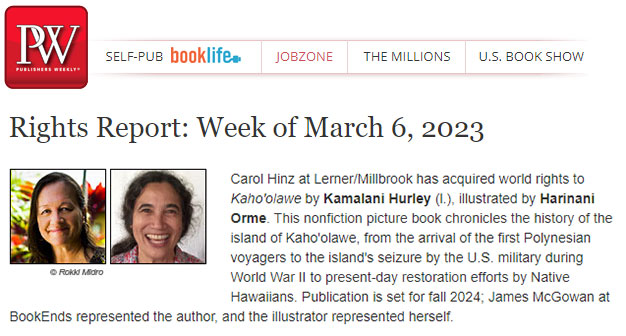
PW announcement

Mahalo ke Akua! After a long career teaching writing (which I really loved), I thrilled beyond words that my debut picture book, KAHOʻOLAWE, has been officially announced at Publisherʻs Weekly!


Kahoʻolawe is a story of loss and erasure, of sacrifice and dedication, and, ultimately, of restoration and resilience. Written and illustrated by Native Hawaiians Kamalani Hurley and Harinani Orme, this childrenʻs picture book is the story of aloha ʻāina — a deep love of the land — and explores what happened to Kahoʻolawe and how she is a beacon of hope for the Native Hawaiian people and for people everywhere who fight against social and environmental injustice. 

Mahalo nui …

  • to the leaders of the Protect Kaho’olawe ‘Ohana for their expertise and support of this project. Their dedication to Kahoʻolawe and to the Hawaiian people continues to inspire. 
  • to editor and publisher, Carol Hinz, whose expertise and patience we are counting on to get the book into the world.
  • to my agent James McGowan, who always knew this story needed to be told.


image credit: Vicki Palmquist — Winding Oak

Interview with Native Hawaiian Artist Brook Kapūkuniahi Parker

Brooke-Parker

We are delighted to feature the accomplished Native Hawaiian artist and historian, Brook Kapūkuniahi Parker. He has illustrated several children’s books for ʻAha Pūnana Leo Hawaiian Emersion Schools and created numerous stunning commission pieces for clients throughout Hawai’i. His passion is to Brooke-Parkercreate breathtaking art that brings life to our ancestors, and he does so through his extensive knowledge of  Native Hawaiian history and culture. 

For those who haven’t met you, could you please tell us a little about yourself?

I have always loved to draw since I was little but only started painting in 2009. I’ve been married for 32 years, 5 children, two grandchildren. My biggest supporter is my wife and business partner, Drena. 

Where did you grow up? What high school did you grad from? 

I was raised in Kahaluʻu, Heʻeia, and Kāneʻohe, Oʻahu. I attended Castle High School and graduated class of ’79. 

Go Knights! Why did you become an illustrator? Did you always know you could create art?

KamehamehaI learned art by watching my dad create his art. I am passionate about family history and honor the ancestors by painting their stories and accomplishments. 

Note: Brook’s father, David Kaleiomanoanahulu Waipa Parker, was a gifted writer and aliʻi member of the Royal Order of Kamehameha.

What do you enjoy most about creating art? What are some of your greatest challenges?

I enjoy telling the stories of our kūpuna and keeping their names and memories alive visually.

What are your hopes and dreams for the year and beyond in terms of your artistic career and what you would like to see published in the future?

Brook-Parker-artI am thankful I am able to provide for my family by painting and hope to publish a book on the Great Chiefs of Hawaii which will include the art I have created.

We are looking forward to that! There are not a lot of Native Hawaiian, Pacific Islander or people of color kid lit illustrators. Why do you think that is?

Yes, I agree. We need more Pacific nation artists to tell our stories through our own eyes.

Do you have a website? Are you on  social media?

My website is Hawaiian at Art. Iʻm also on Instagram and Facebook

What advice would you give an aspiring illustrator?

Don’t give up, holomua, move forward, improve your skills, and be passionate about what you do.

Can you share a bit of your current work?

I am currently completing a large painting of Chief Kaiana with his brothers, Nahiolea and Namakeha.

Where do you get your inspirations? 

Liliʻu-TributeFrom books, stories and other gifted artist I admire.

Illustrators and artists, like writers, do a lot of research when theyʻre creating. Whatʻs your research process like? 

I study, meditate and pray before projects.

Can you share a bit about what you’re working on next? 

Iʻm not quite sure yet, maybe something of a Hina vibe.

We have much to look forward to from you! Mahalo, Brook, for sharing your manaʻo! To learn more about Brook Parker and to view samples of his art, visit his website at Hawaiianatart.org and follow him on Instagram

Interview with Author Vera Arita

Vera-Arita

Hawaiʻi-based author Vera Arita has spent her life helping special-needs children to succeed. Her childrenʻs books focus on Hawaiʻi themes and encourage children to  delight in the world around them. 

Vera-AritaMahalo, Vera, for allowing me to feature you on my blog. For those who haven’t met you, could you please tell us a little about yourself?

Aloha all! I’m Vera Arita, and I am a retired special education teacher.  I taught for 32 years, and then I retired from Mililani Ike Elementary in Central Oʻahu in 2016. I am currently a half time field service instructor at the University of Hawaiʻi at Manoa, and I help students learn how to be special education teachers. I live in Mililani with my husband, Neal, and we have two sons/two daughters-in-laws, two grandsons and a granddaughter. 

Where did you grow up? What high school did you grad from?

I grew up in Waipahu and went to Waipahu Elementary, Intermediate and High School.

Go, Marauders! Who is your biggest supporter?

For sure my husband, Neal, our sons and extended family! I also have great teacher and church friends who come out full force to support my book signings.

Why did you become a writer? What inspired you to write for children?

All-Around-The-IslandsIn my teaching career, I always had a dream to write children’s books to share the love, care and life lessons I’d grown to appreciate. I believe the inspiration also comes through my faith in Christ. My first book, All Around the Islands, came out in 2005.  I dedicated my first book to my parents, Bolo and Eileen Soneda, because my dad was very ill, and Iʻd promised him that I would write a book someday. 

What do you enjoy most about writing for kids? What are some of your greatest challenges in writing for children?

Alphabet-HukilauI think having kids learn about animals or the sounds of the letters in rhyme is very rewarding. My fourth book, Alphabet Hukilau, was written on an iPad! I was just kicking around with the idea of a net catching letters instead of sea animals. At the back of the book there is non-fiction information of the sea animals since much of our content standards deals with reading non-fiction books. 

The challenge for any author is finding a publishing company who is willing to risk creating a book with your words. 

What are your hopes and dreams for the year and beyond in terms of your writing career and what you would like to see published in the future?

Teaching children has been, and is, my passion, and currently my publisher is considering a counting book that is quite whimsical.

There are not a lot of stories for or by Native Hawaiians and Pacific Islanders. Why do you think that is? What do you think we can do the change that?

Again, you have to find a publishing company who believes in your writing.  I believe that in Hawaii, most publishers have to cater to the tourist market for their books to sell. I’m hoping that my new book, which promotes character education, will be in all schools in Hawaii and nationwide.

Do you have a website? Are you on social media? Do you do school visits?

I do not currently have a website, but I am on Instagram Verasonedaarita or you can email me. I do school visits where I share the writing process and share sketches of how a book is formed.  I often browse through reviews on Amazon of my books and find it very humbling to get such rave reviews.

What advice do you have for aspiring writers?

Never give up on your dreams. You have to reach out to many publishers and not get discouraged. My publisher told me she receives submissions nearly every day, and few are picked up to be published.

Can you share a bit of your current work?

Alohasaurus is a story that I think many people can really relate to.  It’s about a dinosaur who has no friends because he looks different, and he sounds different.  In Alohasaurusmany ways it’s like my brother, Mike, who, was socially“different.”  Mike was born with mental and physical challenges.  Sadly, Mike recently passed away in early September 2022, so he did not get a chance to see the book.

In the story, a group of curious and courageous children befriend the dinosaur, and in turn, he teaches them ways to be kind and how to model aloha. Through their newly found friendship, they name him “Alohasaurus.”

As a substitute teacher, I’ve been test marketing the draft of the book with students, and it has gotten “5 star” reviews from them! I have even shared the book with some middle school students, and they really liked the story. Their encouragement has been uplifting and so precious.

Which of your books did you have the most fun writing? Which was the most challenging?

Animals-Sing-AlohaMy third book, Animals Sing Aloha. It is a phonics book that teaches how to write and sound out the alphabets correctly. It was a surprise because the draft was literally written on the back of an anniversary card while I was in a Maui hotel lobby on vacation. I tell students that when inspiration hits, you have to be ready to write!  That book has been my best-selling book to date.

Most challenging is Alohasaurus because it’s been on the back burner since 2007!  I wrote the draft on the back of sermon notes in church and always felt that this would be a great book; however, the publisher wisely was waiting for the right time to create it — and now is the time!

What beliefs are your books challenging?

They challenge peoples’ beliefs that you have to look and act like everyone else to be successful. The lesson to the readers is that you can be a success if you are kind to others, speak respectfully, work hard and are a team player.

What’s your experience with publishing your books?

I learned that when you sign a contract, all your future manuscripts go to them first and if they reject it, then you are free to go to another publisher. Also, the publisher can edit your writing if they feel it flows better a different way. There needs to be trust that the publisher knows what it takes for a successful book; however, there may be times when you must persevere and not give up on a rejected book.

Where do you get ideas for your books?

Can-You-Catch-A_Coqui-FrogIt seems that difficult family times provided inspiration for me to write. In 2006 my brother, Mike, had a seizure and hit his head very hard and became brain-damaged.  While he was in an extended coma, I promised to write another book and dedicate it to him. Thus, Can you Catch a Coqui Frog was written. 

Authors write to persuade, inform or entertain.  My books fall between informing and entertaining. As a teacher I couldn’t find a book that mentioned all eight Hawaiian Islands, so that’s how All Around the Islands came about.  Alohasaurus mentions different kinds of caring for people and for our ʻāina.

Which characters do you relate with easily? Why?

In fictional stories, I relate to the character who really aren’t outstanding, but through much determination and hard work, they are able to achieve a lot.  One of my favorite bible verses is Philippians 4:13: I can do all things through Christ Jesus. A good example of this is that I recently decided to enter the Honolulu Marathon with three months left to train. I did it 10 years ago but trained for a year back then. With the Lord’s help, I can do it again.

Mahalo nui, Vera! To contact Vera Arita and learn more about her books, please follow her Verasonedaarita in Instagram.